


This one’s big.
OpenAI seems to be building an analytics dashboard that shows businesses how often they appear in ChatGPT answers and how often people click through to their sites.
Juozas Kaziukėnas spotted it and posted about it on LinkedIn this morning (h/t Hanns Kronenberg for flagging it). Here’s what we know so far:
Two numbers, tracked daily. Impressions count how many times your business showed up in a ChatGPT response. Clicks count how many times someone clicked a link to your website. Both appear in a daily chart.
It’s part of a bigger “Business Hub.” According to Search Engine Roundtable, the hub pitches businesses on claiming your business in ChatGPT, keeping your products and business info current, and letting a “business agent” answer customer questions using context you control.
You have to prove you own the business. It’s only open to verified businesses. Connecting your Shopify store is one way to verify.
It’s been in the works for a while. Kaziukėnas first saw early pieces of it in August. A banner that appeared today suggests a launch is getting close.
What’s missing. It doesn’t show the prompts people typed, any user data, or how you stack up against competitors. So, AI search platforms like our VisibilityIQ platform still can help there.
One caveat before I go any further is that OpenAI hasn’t said anything officially.
This feature was spotted in testing, and features in testing change or get killed all the time.
So… is this ChatGPT Search Console v1?
Mostly, yes. But I think it’s a bigger deal than that.
Google has two separate free tools for businesses.
Search Console tells you how your website performs in search.
Google Business Profile lets you claim your business, update your info and talk to customers.
What OpenAI is reportedly building puts both of those in one place: claim your business, upload your products, set up an agent to answer customer questions, then see how you’re performing.
OpenAI is building the front door for every business that wants to be found inside ChatGPT.
Hot take #1: The click data is the real story
This is the part almost nobody is talking about.
Google and Microsoft already give you AI visibility reports, and both of them hold back click data.
Google Search Console (AI Overviews + AI Mode), launched June 2026: shows impressions. No clicks, no queries, no competitor data.
Bing Webmaster Tools (AI Performance), launched February 2026: shows citations and the “grounding queries” behind them. No clicks, no competitor data.
ChatGPT (reported, not launched yet): shows impressions and clicks. No prompts, no competitor data.
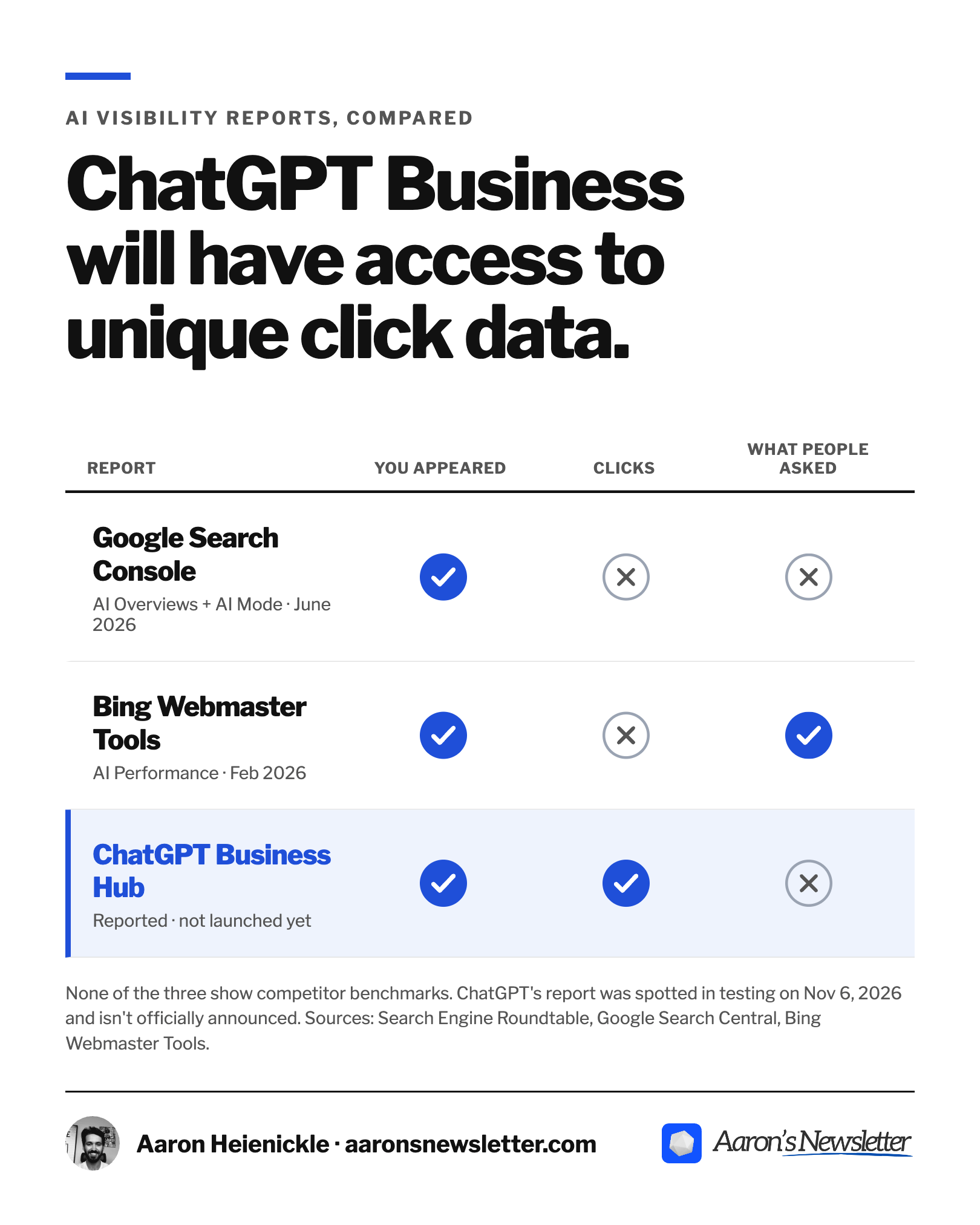
Google’s generative AI report, launched June 3, gives you impressions and nothing else. No clicks, no click-through rate, no queries, and AI Overviews and AI Mode are lumped together. Bing’s report counts how often Copilot cites your pages, but it doesn’t show clicks either.
So why would OpenAI be the one to show clicks?
Because it wants to prove it sends you traffic. Google has every reason to keep you from seeing how few clicks its AI answers send out. OpenAI has the opposite problem: it needs you to believe ChatGPT is a real traffic source, because…
Hot take #2: Free analytics is the on-ramp to ChatGPT Ads
Follow the timeline:
February 9, 2026: ChatGPT starts showing ads to free and Go users in the US.
May 5, 2026: OpenAI opens a self-serve Ads Manager to any US business, with no minimum spend and cost-per-click bidding.
August 31, 2026: OpenAI says ChatGPT Ads hit a $1 billion annualized run rate, in under 200 days.
Now: a free dashboard that shows businesses their organic ChatGPT impressions and clicks.
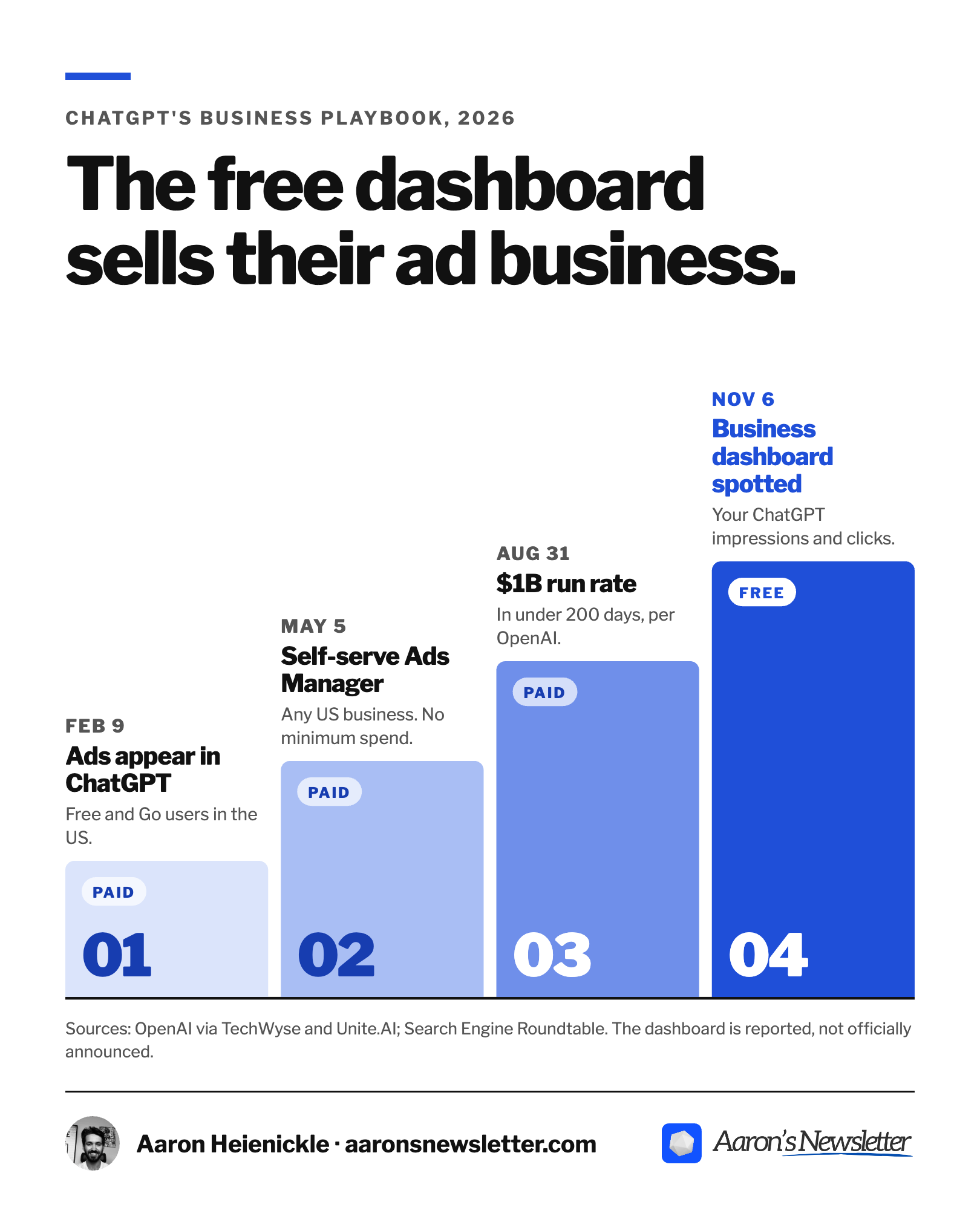
This is exactly what Google did. Search Console is free. It shows you where you rank, gets you hooked on the numbers and, sooner or later, sends you to Google Ads to buy the spots you’re missing.
My prediction: within a year of launch, this dashboard will show your organic numbers right next to a button that says something like “Reach more customers.” The free scoreboard sells the paid game.
Hot take #3: Verification is the land grab
To get the dashboard, you have to verify your business. To verify, you connect your Shopify store (or something like it). Once you’re connected, you’re handing OpenAI your product catalog, prices and business details, and possibly the instructions your “business agent” uses to talk to customers.
That’s a great deal for OpenAI. It gets clean, structured, first-party data straight from the businesses themselves, which is exactly what makes ChatGPT shopping answers better. And it’s probably a good deal for you too. Just know what you’re trading.
Hot take #4: GEO tool vendors aren’t dead. But some are in trouble.
There’s a whole industry now of “AI visibility” tools (Peec AI, Scrunch, AthenaHQ, SE Ranking’s tracker, dozens more) that estimate your ChatGPT presence by firing prompts at it from outside and counting mentions.
OpenAI’s dashboard won’t replace them. It doesn’t show prompts, competitors or why your numbers move.
As Kaziukėnas put it, it tells you whether your AI strategy is working, and you still need outside tools to understand why.
But any vendor whose entire pitch is “we’ll tell you if ChatGPT mentions you” just lost its moat. When the platform hands out first-party numbers for free, estimates start looking like guesses.
The tools that survive will be the ones that explain the why… which prompts, which competitors and which sources ChatGPT trusts.
Let’s keep this in perspective
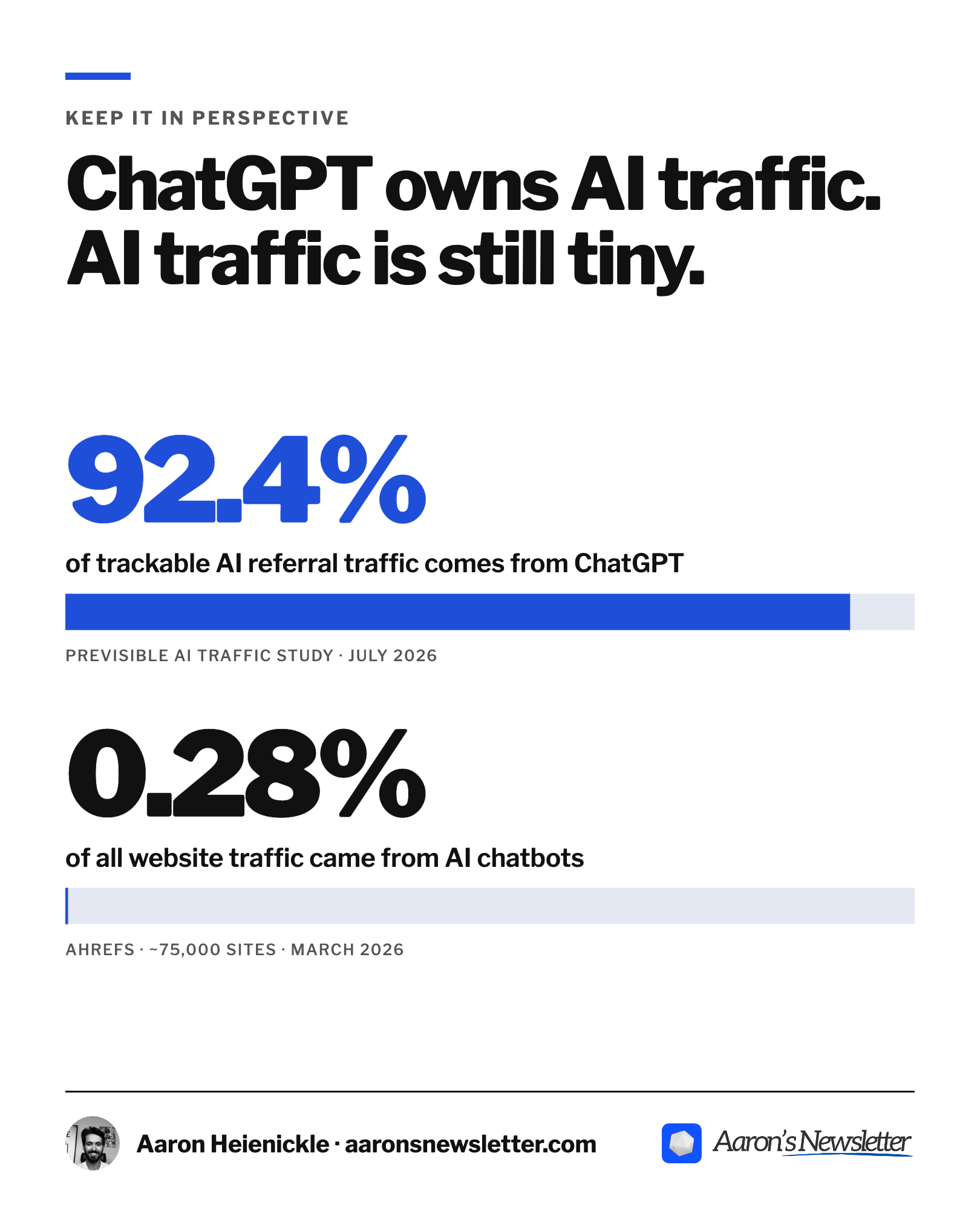
ChatGPT is huge. OpenAI’s Nick Turley said in February it had around 900 million weekly users. And it sends most of the AI-driven traffic on the web: Previsible’s July study put ChatGPT at 92.4% of trackable AI referral traffic.
But AI referrals are still a sliver of total traffic. Ahrefs found that AI chatbots sent 0.28% of all traffic across the nearly 75,000 sites it tracked in March 2026. For most businesses, Google is still the main event.
The opportunity I see here is that, for the first time, you can measure a channel that has been a black box with first-party data from the source.
What to do this week
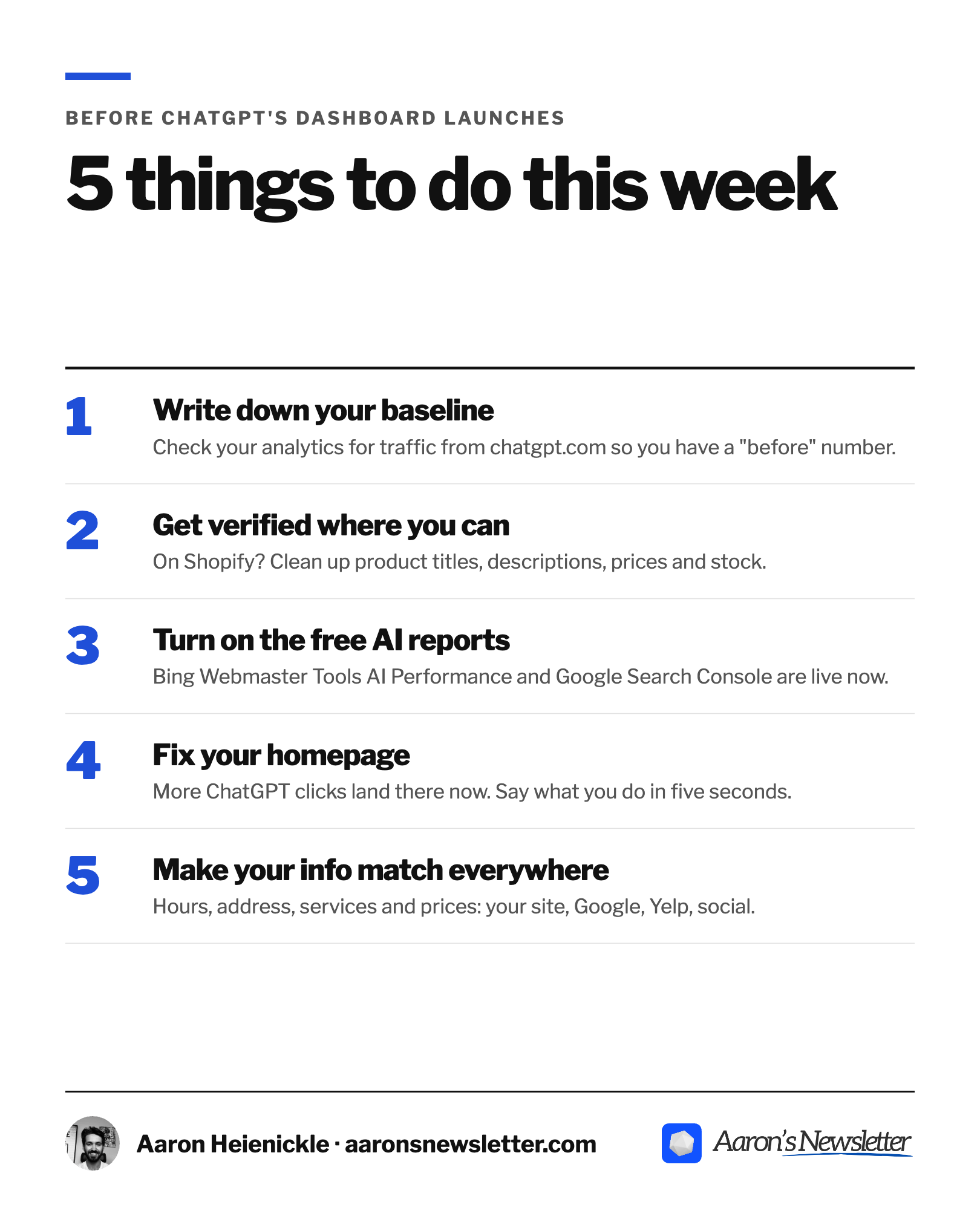
Write down your baseline now. Before this launches, check your analytics for traffic from chatgpt.com. When the dashboard arrives, you’ll want a “before” number.
Get verified where you can. If you’re on Shopify, your store is the likely way in. Make sure your product data (titles, descriptions, prices, stock) is clean, because that’s what ChatGPT will read.
Turn on the free AI reports you already have. Bing Webmaster Tools’ AI Performance report is live today, and you can import your sites from Google Search Console in a couple of minutes. Google’s generative AI report is rolling out inside Search Console.
Fix your homepage. After a ChatGPT update on May 7, the share of ChatGPT referrals landing on homepages jumped from about 25% to nearly 60%, according to Similarweb. Your homepage needs to answer “what do you do and why should I care” in five seconds.
Keep your business info consistent everywhere. Hours, address, services and prices should match across your site, Google, Yelp and social media. AI answers pull from all of it.
The bottom line
OpenAI is doing what every platform does once it gets big enough: build tools that make businesses depend on it. First the scoreboard, then the shop window, then the ad auction.
The businesses that win won’t be the ones that panic about AI search. They’ll be the ones that start measuring it before their competitors do.
I’ll be watching this one closely. If you see the Business Hub banner in your account, hit reply and tell me what it shows.
Sources
Search Engine Roundtable: OpenAI Working On ChatGPT Tools For Business
Search Engine Land: OpenAI testing business tools to track performance within ChatGPT
Digital Applied: Google Search Console’s AI performance report
TechWyse: OpenAI Opens ChatGPT Ads Manager to All U.S. Businesses
More from me:
Learn how to pitch a business the fun way.
Get Products: The Card Game: Get my game where ‘Shark Tank’ meets Apples to Apples.
Wanting to stay ahead in search? Get Pluto - my FREE AI Visibility Chrome extension
Pluto - The Free AI Visibility Extension: I wanted a simple way, right inside the browser, to see: “If an AI model or search engine reads this page, what does it actually see?”
Share the newsletter and get rewards
Refer friends for rewards: Get cool rewards (like my card game) for referring people to my newsletter. Check out where you stand on the leaderboard.