


Everything Claude has written for you since August 2nd includes a signature.
At first, you’d assume it’s some special character, invisible to human sight but sitting there in the text. It’s actually weirder witchcraft than that. The signature lives in the words that were picked.
So what got everyone talking about this over the last week?
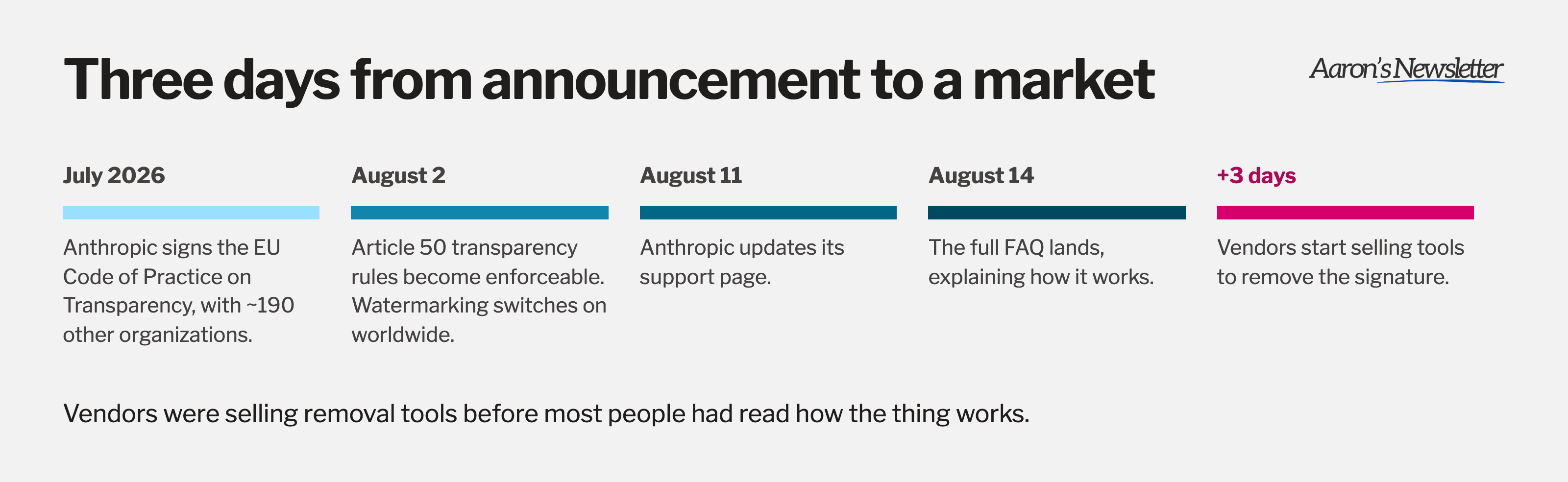
On August 11th, Anthropic updated its support page about it, then released a full FAQ on the 14th explaining how it works. Three days after the first announcement, vendors started selling tools to remove the signature.
And I have a lot to say about those tools.
These tools are less noteworthy than the concerns that are driving people to use them. The main concern I have been hearing is a fear of a decline in site performance.
This is a totally valid thing to be thinking about as a marketer, after this news.
If you’ve used Claude in any way over the last two years, for editing, research, or publishing, you might be sitting on a pile of pages that can be identified as machine-assisted.
And, for many people, that sounds like a potential big problem. It also didn’t help many’s fears after about a dozen social media posts this week told you it is one.
So, this whole newsletter comes down to two big questions people have been asking:
Is Google going to punish my site for having the Claude Watermark?
Should I pay someone to remove the Watermark?
But before I can answer that, we need to dive into the science behind watermarks and why that matters for this story.
The science behind the watermarking
LLMs like Claude work by generating text one word at a time. At each step, it considers a shortlist of possible words and selects one.
For example, in the sentence “The weather today was cold and…” the next word won’t be “sugary.” It will most likely be “overcast” or “grey,” and either choice means the same thing.
Normally, a random number decides which word is picked.
Watermarking changes how that randomizer works. The model uses a secret key and the previous few words to decide between options. Then, choose the output that matches the key.
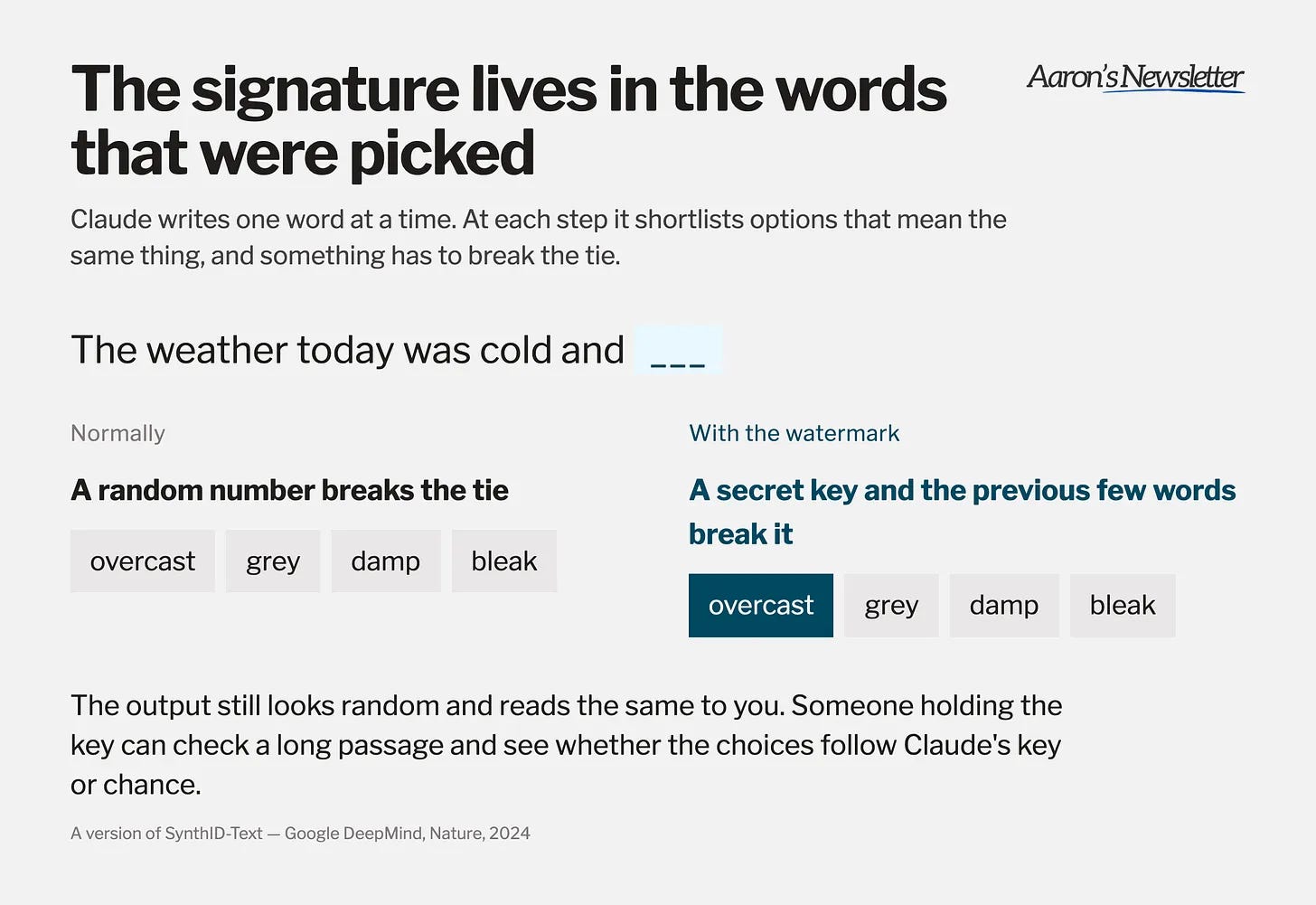
The output still seems random and reads the same to you. Yet, a script with the key can review a long passage, check the sequence of choices, and figure out if those choices match Claude’s key or are just random.
Anthropic analogies this to playing Monopoly without rolling dice. Instead, everyone uses the next digit of pi, starting from a random spot. The game feels normal, and no one notices. Later, if you know the trick, you can look at all the moves across the game and see that it followed pi.
This technique is a version of SynthID-Text, which Google DeepMind published in Nature in 2024. Earlier versions include a 2022 proposal by Scott Aaronson and a 2023 “green list” method from John Kirchenbauer’s team at the University of Maryland. So, the science has existed for three years, but it has not become mainstream until some of the legal requirements I will discuss later came into effect.
Does watermarking affect writing quality?
So far, I don’t see any evidence that it does.
For example, DeepMind tested the watermarked model on live Gemini traffic and compared user ratings with those of the unwatermarked version. They found no significant difference in users’ ratings.
Another study demonstrated that human raters couldn’t distinguish between watermarked and unwatermarked answers. So, in other words, the watermark likely had no impact on users’ impression of quality.
What is also good for Claude users is that no extra tokens are generated, so there’s no added cost or slowdown. Anthropic also says in its FAQs that “the watermark doesn’t include anything that identifies you, your company, or your conversations.”
Where the watermark doesn’t apply
Most social posts skip this part, but it’s important.
The watermark only works in places where word choice doesn’t matter much. Meaning, it quickly disappears in sections where every word is important.
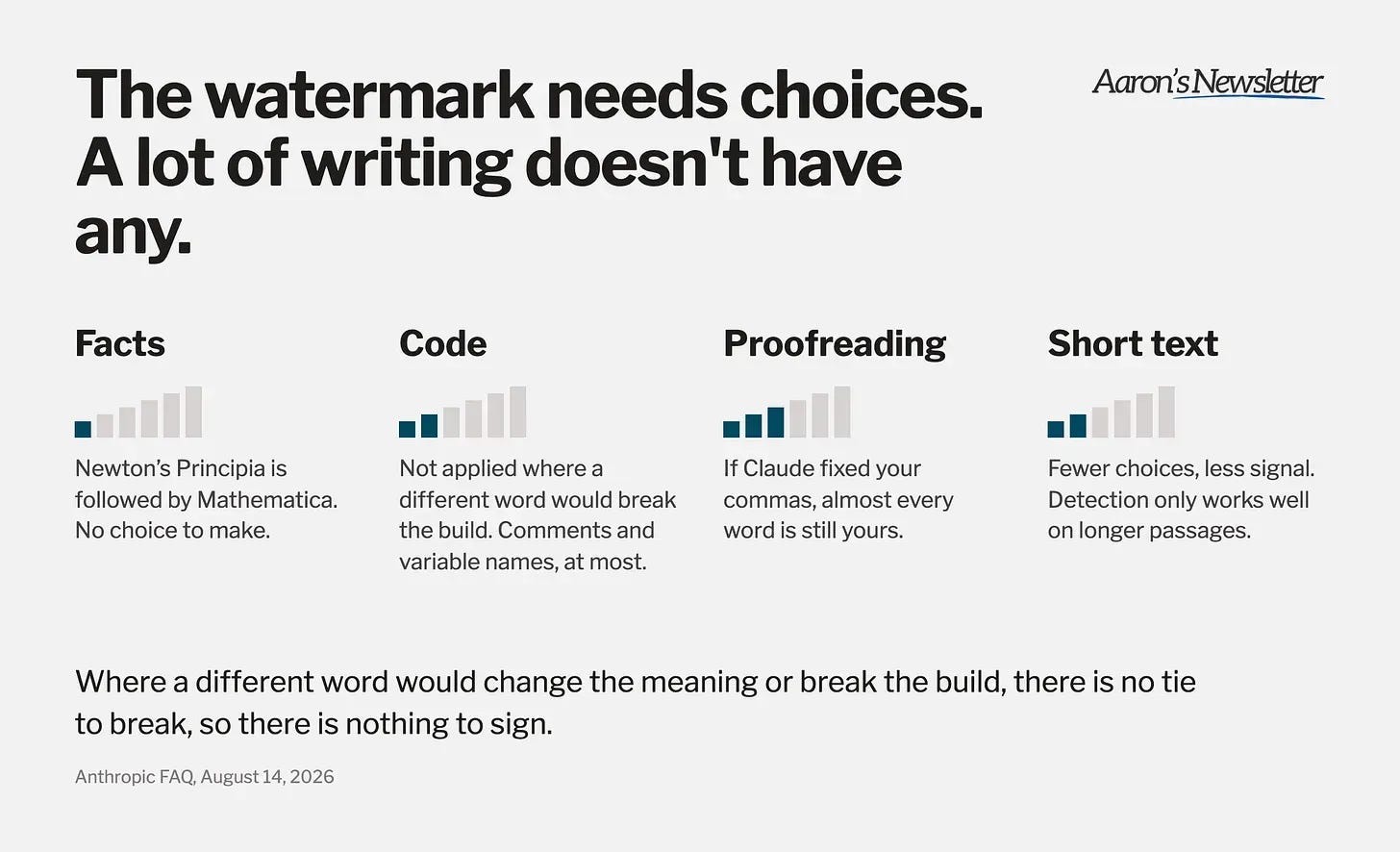
What are examples of sections where every word is important?
Facts are one.
If Claude writes “Isaac Newton’s most famous work was called Principia…” the next word must be Mathematica. There’s no choice to make. It’s a 100% probability that the next word is Mathematica. So, a watermark can’t be added there.
Code is another clear case.
Code needs to be exact; using one different variable for a script could crash a program. Fortunately, Anthropic says the watermark isn’t used where a different word would break the code. It might appear in comments or variable names, but that’s about it. So if you’re worried about your code repositories, you can take that stress off your back.
Proofreading is similar.
If you write something and Claude fixes your commas, almost every word is still yours. There might not be enough code words for the watermark to attach to.
Short texts are also less likely to be watermarked.
With fewer word choices, there’s less signal, and detection only works well on longer passages.
It’s also important to remember that a detected watermark only shows that Claude was involved.
It can’t tell if Claude wrote the whole thing or just edited it.
Translating a paragraph, rewriting an introduction, or tightening an ending all leave the same trace as generating new text.
Why is this happening now?
The main reason is the EU AI Act and its associated penalties.
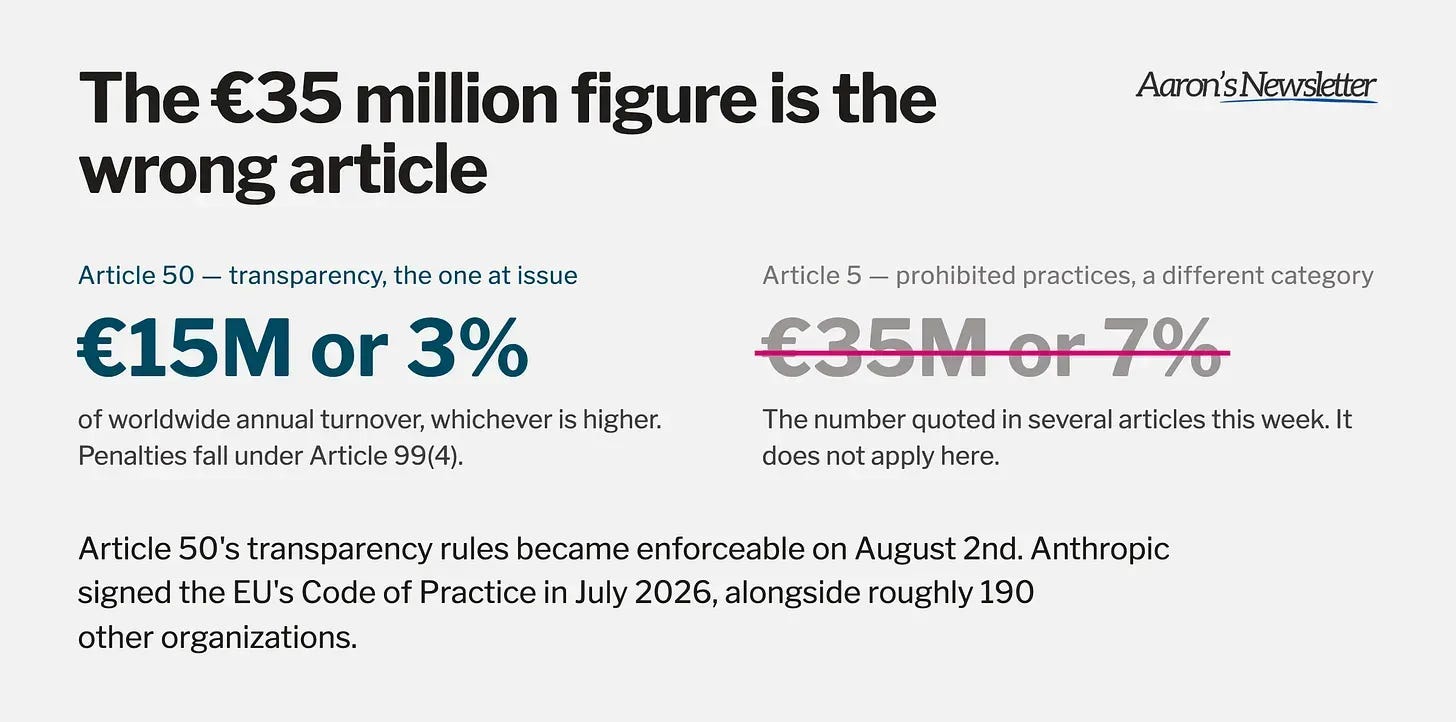
Anthropic signed the EU’s Code of Practice on Transparency of AI-Generated Content in July 2026, along with about 190 other organizations. Article 50’s transparency rules became enforceable on August 2nd.
And Article 50 violations fall under Article 99(4), with penalties up to €15 million or 3% of worldwide annual turnover, whichever is higher.
Anthropic enabled watermarking worldwide instead of just in Europe because, according to them, they don’t yet have a reliable way to limit it by region.
Meaning, there’s no opt-out, and other labs signed the same agreement, so more of this is on the way. Google has already been watermarking Gemini output with SynthID for years. And other AI companies like Anthropic are following suit.
I also have another theory about why they’re doing this
The EU's explanation is true and sufficient. They’d have to ship this regardless, and the deadline lines up to the day. But I think there’s a second advantage sitting underneath it.
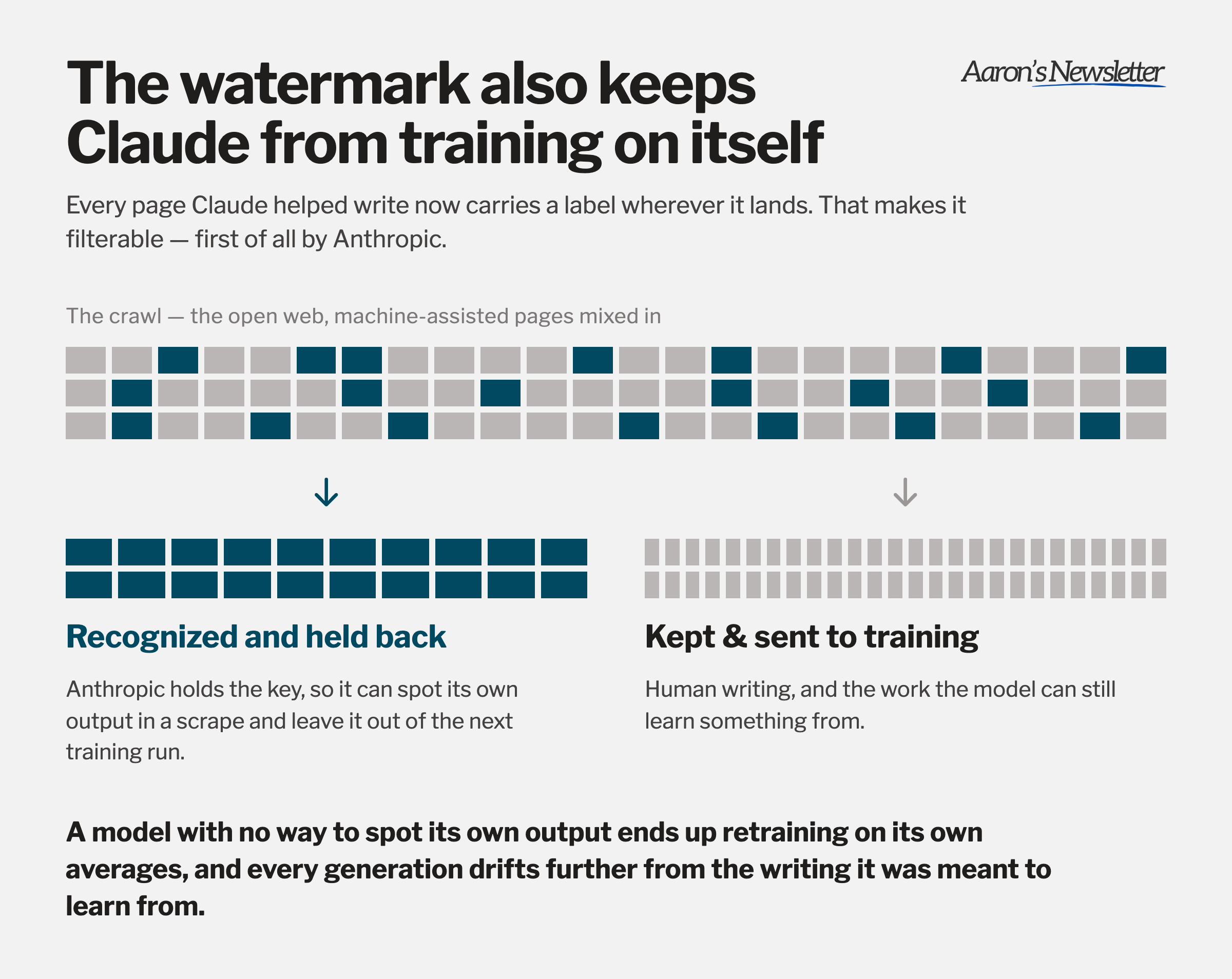
Anthropic crawls the web to train models. Everyone does. And the web is filling up with AI-written text at a rate nobody has a confident number for.
There’s a well-documented problem with that. A viral 2024 Nature paper found that training models on recursively generated data causes irreversible damage. What happens is that the tails of the original distribution disappear, and the output becomes progressively blander with each generation. Feed a model enough of its own exhaust, and it starts self-destructing itself.
So, if you’re Anthropic and you’re planning to crawl the web in 2027 for training data, what would you pay for it?
A cheap, reliable way to spot your own output and drop it before it reaches the training run.
Luckily, for them, that’s precisely what a keyed watermark hands you. While not perfectly, but well enough to strip a meaningful chunk of your own output out of the corpus at effectively zero cost.
And I would also note the asymmetry between each company.
Only Anthropic holds Claude’s key. Only Google holds Gemini. Every lab ends up able to clean its own exhaust out of its own crawl, and nobody else’s. Whether that stays true depends entirely on the detection API Anthropic has promised but hasn’t shipped—specifically, whether they ever open it up, and to whom.
So, I don’t think this is the whole reason they did it. The regulation could explain the whole thing on its own. But it’s a very useful thing for them to get for free, and I’d bet the data teams noticed before the policy teams did.
Do I think the watermark will affect search?
I’ve seen many posts this week calling this an SEO disaster, but I disagree.
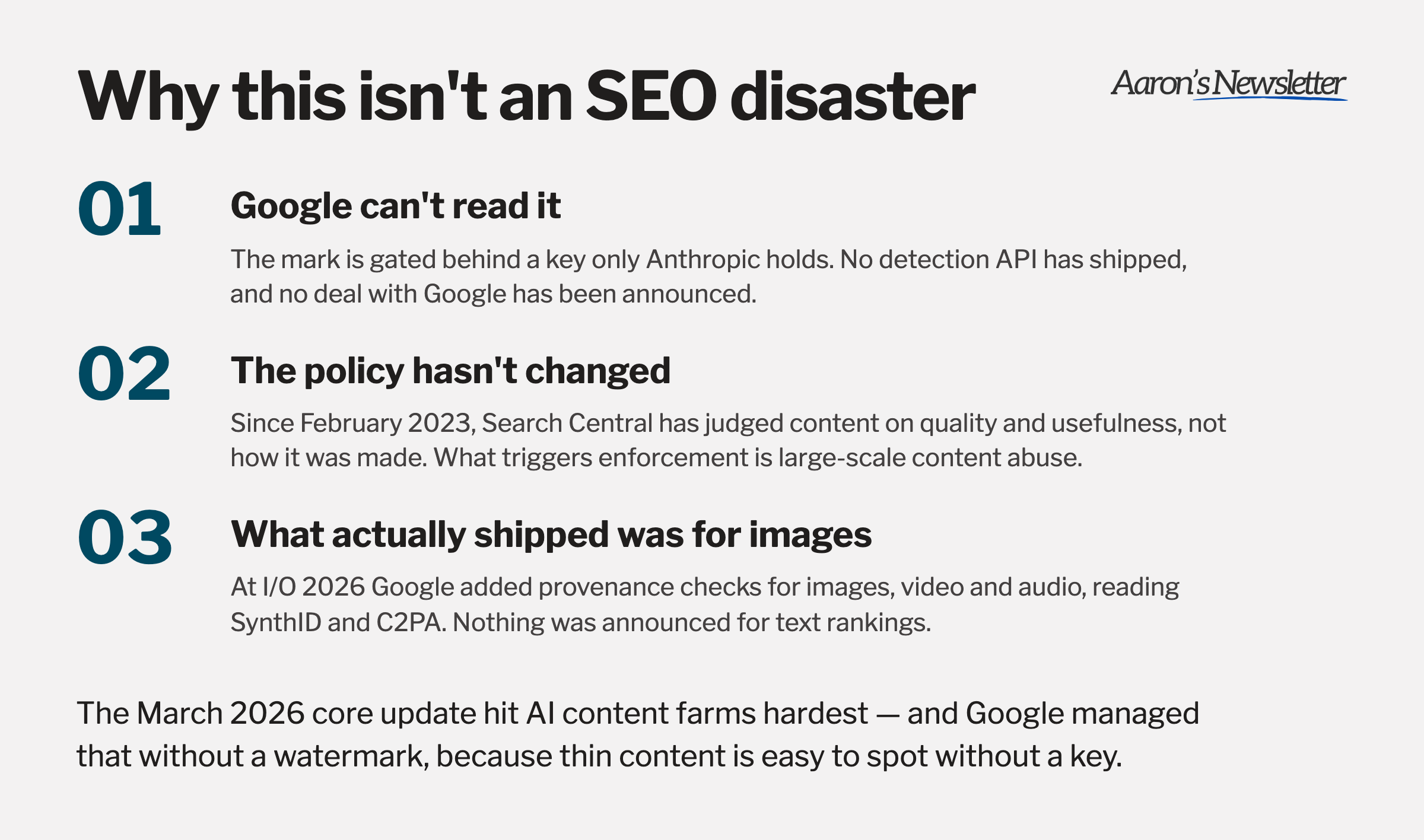
Here is why I don’t think it will affect search:
First, Google can’t read the watermark.
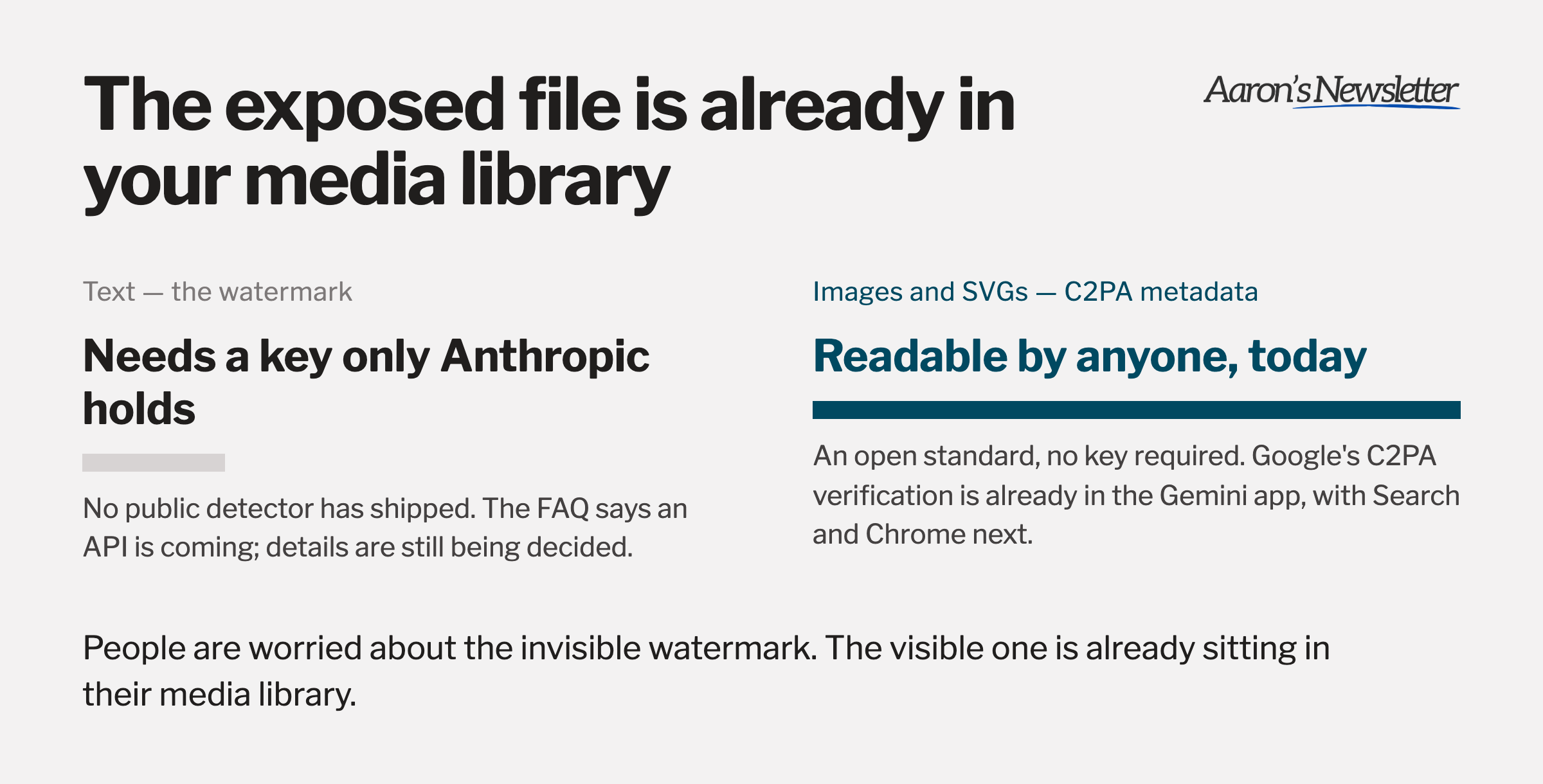
It’s protected by a key that only Anthropic has, and their team has not yet released a detection API. The FAQ says one is coming, but details are still being decided. For Google to use this in rankings, they’d need a backdoor deal with Anthropic. As far as I heard, nothing like that has been announced.
Second, Google’s policy hasn’t changed.
Since February 2023, Search Central has said that content is judged on quality and usefulness, not how it was created. Danny Sullivan repeats this over and over whenever asked.
What triggers enforcement is large-scale content abuse. This means large numbers of pages are created primarily to manipulate rankings, without a concern for user experience, uniqueness, or quality.
That policy has been brutally enforced for abusers. The March 2026 core update focused on it, with Ahrefs and Semrush both reporting that over half of monitored domains changed. AI content farms continue to keep getting wiped.
The important thing here is that Google did this without using watermarks. That is because this content is easy to spot without any special key.
Finally, what Google has actually released is for images.
At I/O 2026, they added provenance checks for images, video, and audio using Lens, AI Mode, and Circle to Search, which read SynthID and C2PA. You can now ask if an image was made with AI. There’s been no announcement about using this for text rankings.
So, I don’t see any reason for the ranking panic. There are two real risks, but they’re not what most people are worried about.
The first risk is disclosure. Many client contracts, freelance agreements, RFPs, and journal submission rules have added AI clauses in the past two years, often without much attention. Soon, verifying those clauses will be easy. If your stated process and your real process don’t match, that gap will be easy to spot once a detection API is available.
The second risk is your image folder. When Claude creates an image, .png, .jpg, or .svg It adds signed C2PA provenance metadata to the file. This is different from the text watermark: it’s an open standard, doesn’t need a key, and any C2PA-aware tool can read it now. Google’s C2PA verification is already available in the Gemini app and will soon be in Search and Chrome. People are worried about the invisible watermark, but the visible one is already in their media library.
The rise of watermark removal tools and why I wouldn’t recommend them.
“Watermark scrubber” is now a product category. Humanizer vendors published guides about Claude within days of the announcement, showing who profits from the anxiety.
The research on this is solid, and it focuses on what really matters: the cost of removing the watermark.
Swapping synonyms doesn’t work. Changing “significant rise” to “considerable increase” only changes the wording, but the sentence structure and underlying patterns stay the same.
Real paraphrasing methods can work. In 2025, a technique called adversarial paraphrasing used a detector to guide rewrites and reduced true-positive rates by about 88% across different detectors. The authors say the tradeoff is “mostly a slight degradation in text quality.”
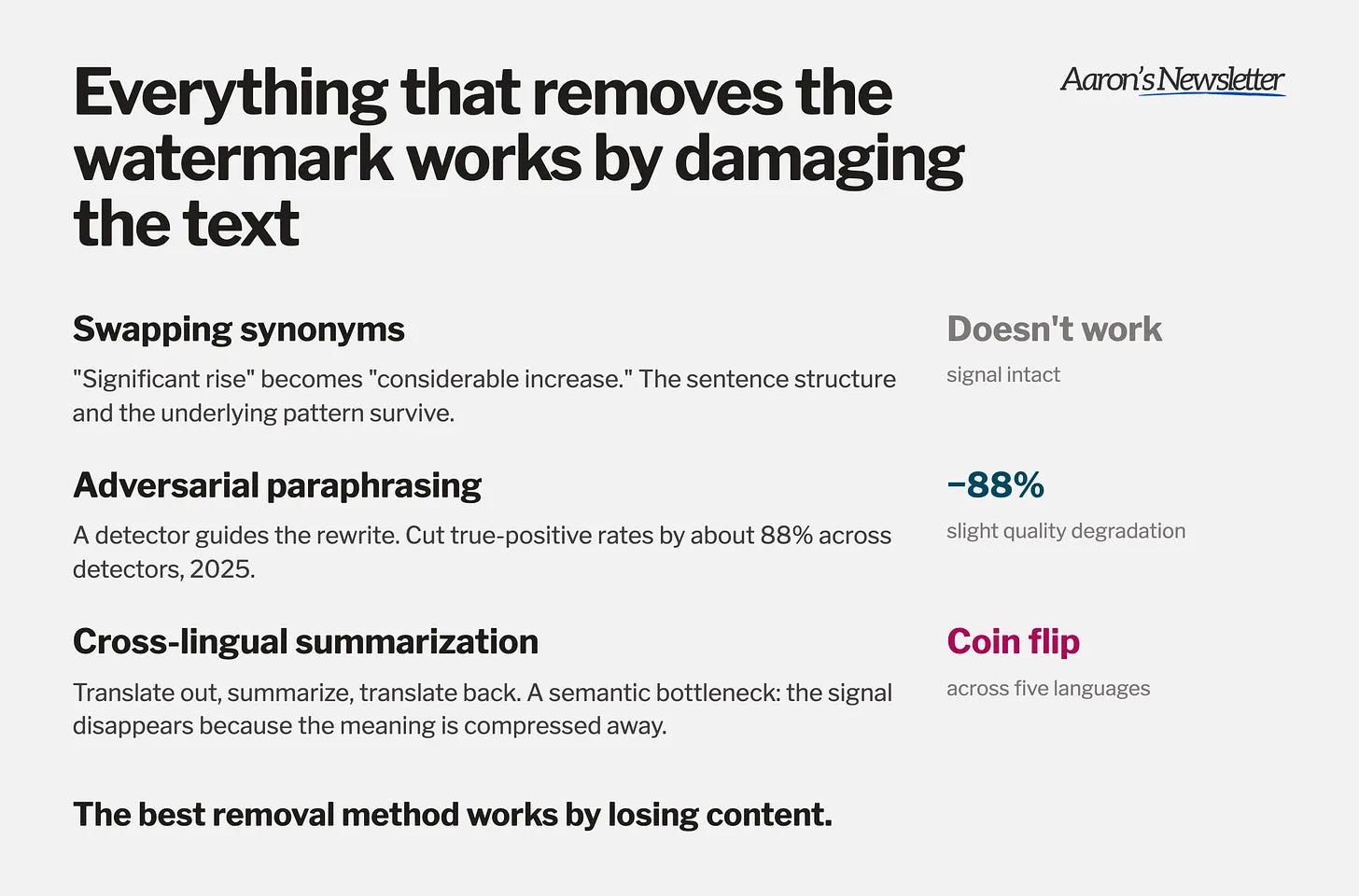
The most effective attack destroys information on purpose. Cross-lingual summarization—translating to another language, summarizing, then translating back—reduces detection to about coin-flip accuracy across five languages, much more than regular paraphrasing. Researchers explain that this method creates a semantic bottleneck, causing the signal to disappear as the text is compressed through a lossy process. The best removal method works by losing content.
There’s one number I found while researching that I found interesting. A 2025 paper titled “Sandcastles in the Storm” tested automated paraphrase attacks on text watermarks and found they succeeded 26% of the time. After a human quality check, it dropped to 10%. About two-thirds of the “successful” removals created text that people wouldn’t accept.
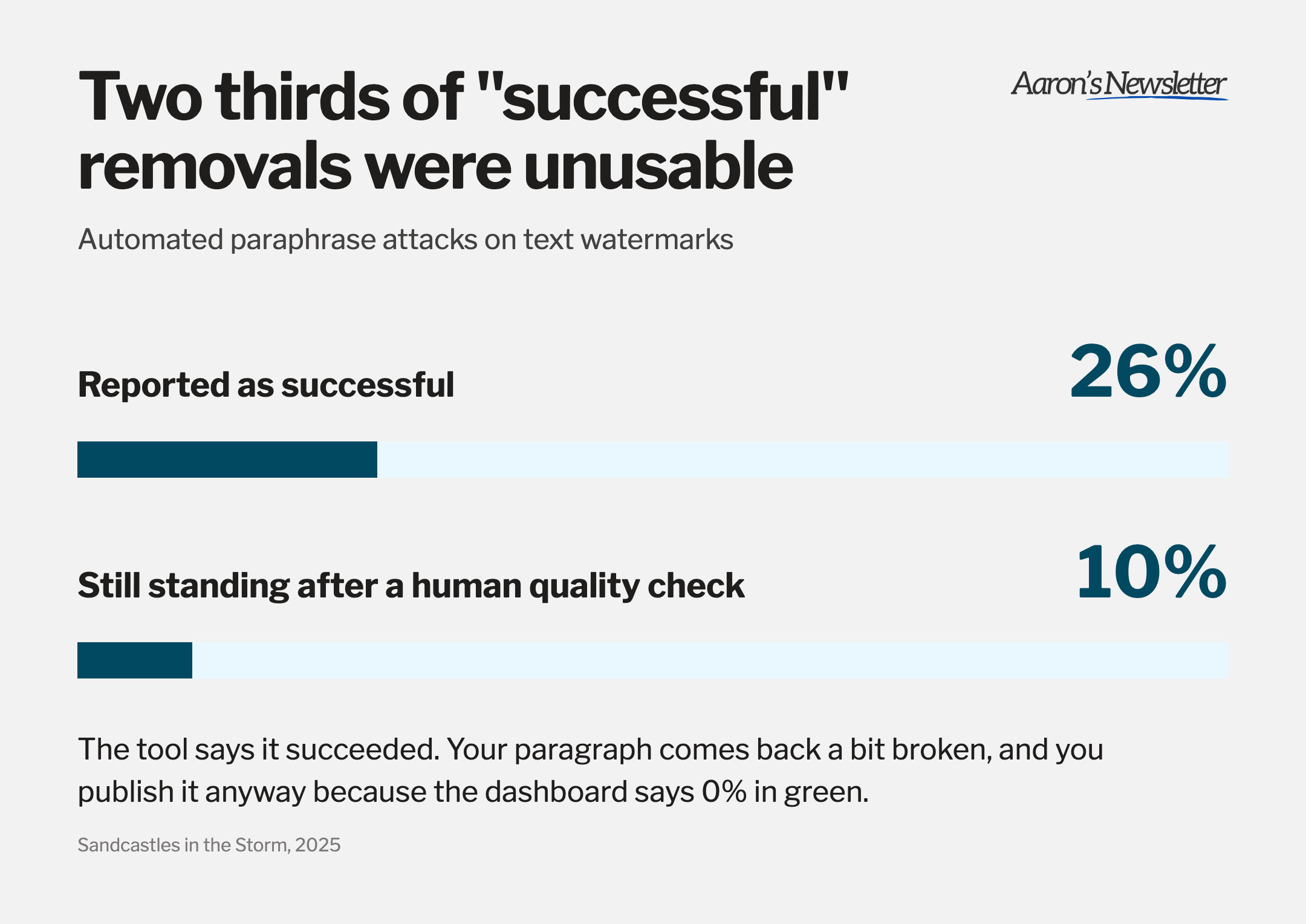
The fact that the scrubbers remove watermarks better than human editors is a key premise of the business model for scrubber tools. Another 2025 study examined 19 humanizer tools and found that many detectors fail to detect them, but at the cost of losing the original meaning. The tool says it succeeded, your paragraph comes back a bit broken, and you publish it anyway because you paid for it and the dashboard says 0% AI in green.
Anthropic is clear about this in its FAQ, too. Light editing probably won’t remove the watermark, but a full rewrite that changes every word will.
At that point, it’s arguable whether the text can any longer be described as AI-generated.
If you were adamant about removing the watermark, the only sure way to remove Claude’s watermark is to write the content yourself.
But I wouldn’t recommend damaging your own work to defeat a signal that search engines can’t even read right now. Google won’t see the watermark, but it will notice the damage — and your audience, for that matter, too.
The grandma’s cookies analogy.
My friend Bryce Murray has a way of looking at this that I really like. He calls it making grandma’s cookies.
Only Grandma knows her recipe, and no one can recreate Grandma’s cookies cause she creates them in her own special way. What makes hers special isn’t the flour, sugar, or chocolate chips. It’s the little bit of extra honey she adds that no one else would think of. Or, the unique twist on baking that no one else would think about
That’s the key point, and it has nothing to do with watermarks.
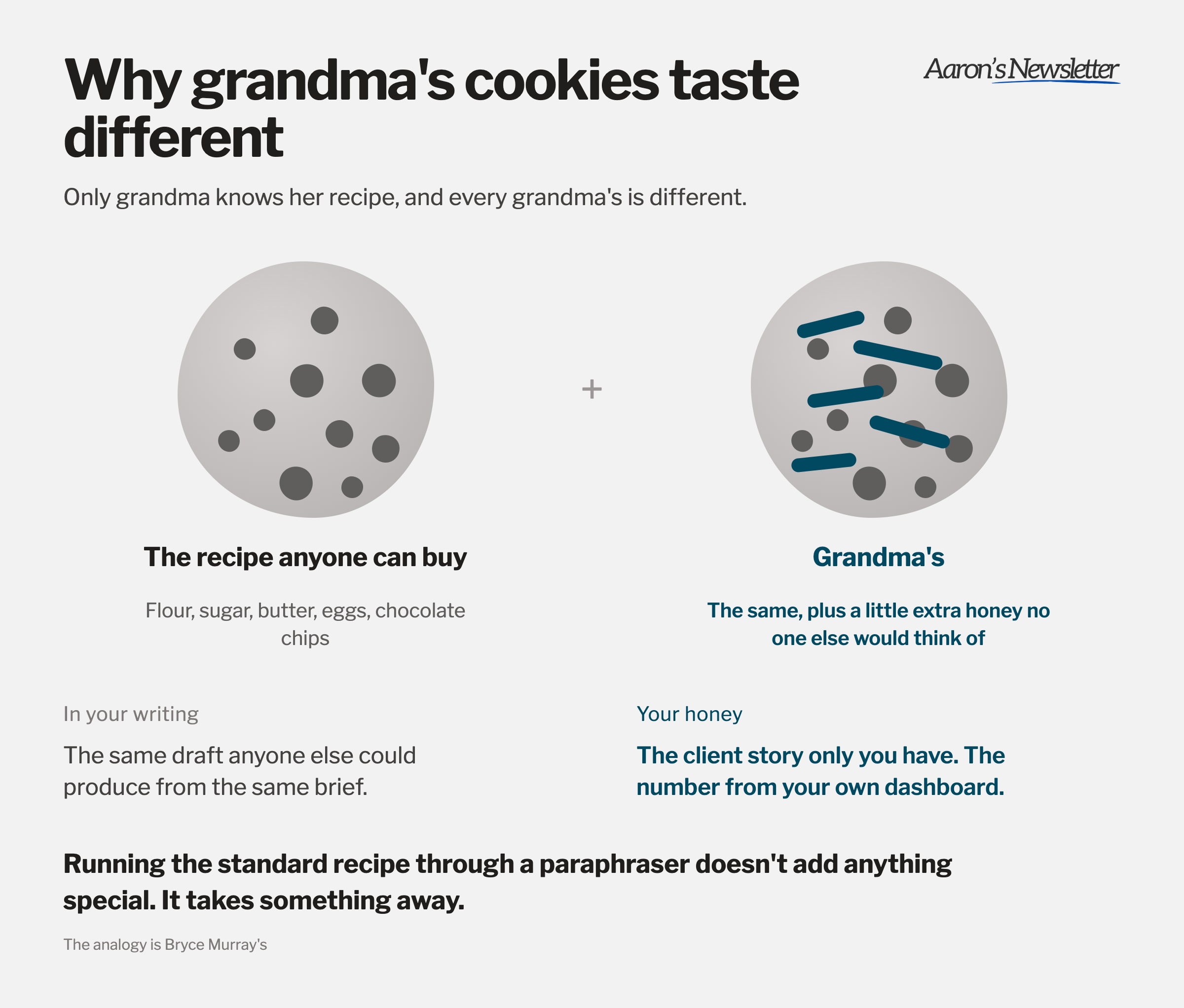
Scrubber tools assume your problem is that your work looks machine-made. But if your content is truly the same as everyone else’s, the watermark isn’t what gave you away. You made cookies from the standard recipe. Running that through a paraphraser doesn’t add anything special; it actually takes something away.
What really sets you apart are things no watermark can touch. It’s the client story only you have, the number from your own dashboard, the opinion you’d defend in a room of skeptics, or the detail you noticed after eleven years of experience. None of that survives a translate-summarize-translate process, but all of it survives a watermark.
What I recommend doing.
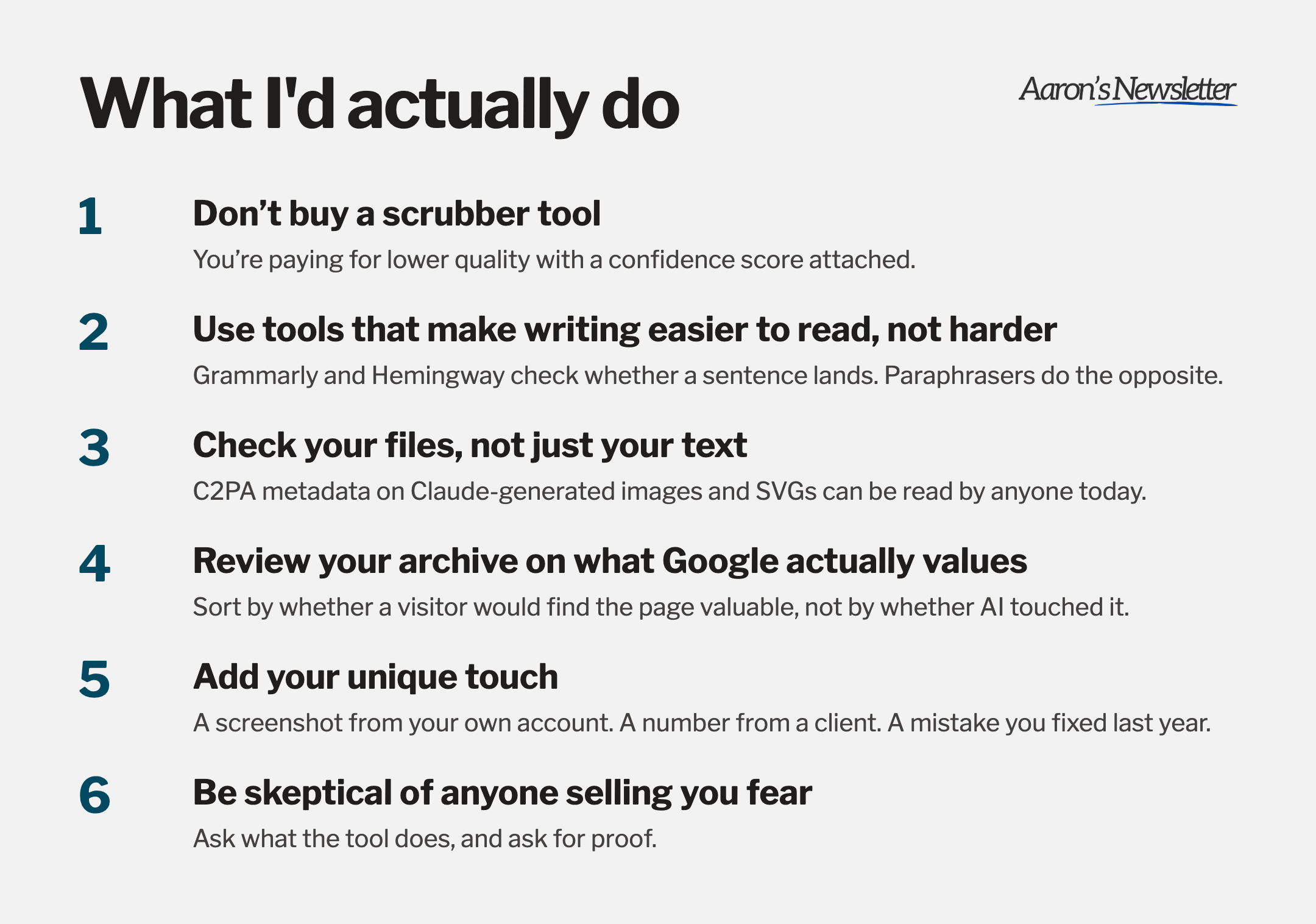
1. Please don’t buy a scrubber tool.
You’re paying for lower quality with a confidence score attached. If the output passes a real human quality check, the watermark probably survived too. If the watermark is gone, you’ve likely lost some of your original meaning.
2. Use tools that make the writing easier to read, not harder.
I run pieces through Grammarly and Hemingway all the time. That’s a completely normal part of editing. You’re checking whether a sentence lands, whether a paragraph is doing too much, whether the reading level matches who’s actually going to read it. Hemingway, for example, will literally find areas where your sentences are too complex.
Anti-watermark paraphrasers do the opposite. They scramble syntax, swap in stranger word choices, and push your reading difficulty up.
These are two completely different subsets of tools both marketed as “text improvers.”
One is trying to make your reader’s job easier.
The other is trying to make a statistical test fail, and your reader pays for it.
Every editing pass should end with the piece clearer, more polished, and more digestible than it started. That’s the only test worth applying.
3. Check your files, not just your text.
C2PA metadata on Claude-generated images and SVGs can be read by anyone today, without a key. If you’re sharing AI-made diagrams, hero images, or social graphics, those are exposed. Your blog posts are not.
4. Review your archive based on what Google actually values.
Sorting your old content by “did AI touch this” isn’t helpful. Sort it by whether a visitor to the page would find it valuable.
That’s what the March update focused on, and Google did fine weeding out slop without watermarks.
5. Add your unique touch.
Instead of spending an hour running old posts through a humanizer, use that hour to add something to each post that only you could have written. A screenshot from your own account. A number from a client. A mistake you fixed last year. That’s the only approach that actually compounds.
6. Be skeptical of anyone trying to sell you fear.
I said this last month about the fake evil-AI market, and it’s the same here. Vendors are selling tools for a threat Google can’t even detect right now, and the best result is only slightly less damage to your work. Ask what the tool does, and ask for proof.
Bringing it all together.
The watermark is a statistical nudge applied to word choices that were arbitrary to begin with. It doesn’t add anything to your text, doesn’t identify you, and doesn’t cost you quality. What it proves is narrow: Claude was involved somewhere in the process. It can’t separate a full draft from a heavy edit; it thins out on facts and code, and it may not register at all on something short.
For search, that adds up to very little. Google can’t read a mark gated behind Anthropic’s key, and nothing shipped this year targets AI-written text in ranking. The pages that got wrecked in March got wrecked for being thin, and Google managed that without any watermark at all. If you’re looking for real exposure, it’s the C2PA metadata embedded in Claude-generated images and SVGs, which anyone can read today.
Which leaves the removal market as the only part of this story that can actually hurt you. Every method that reliably strips the signal works by degrading the text — the strongest one on record does it by deliberately throwing away meaning.
You’d be paying to damage real pages in order to defeat something nobody in search can currently detect. Use Grammarly, use Hemingway, use anything that leaves the piece clearer than it started. Then put in the thing only you could have written.
So, quick recap
Can Google even read this thing?
Does watermarked content get demoted?
Do you need to go back and scrub 400 posts?
And if you did strip it out, what does that actually cost you?
My short answers are no, no, no, and considerably more than the vendors selling you the fix are letting on.
And, at the end of the day, a detected watermark only says Claude was in the room. For the majority of the top SEOs and marketers, that’s been true for the last few years.
So, if you are focusing on quality and your own version of ‘grandma’s cookies’ in your work, I don’t think this new watermark should be anything to fear. And, please don’t spend money on a Claude watermark removal tool.
More from me:
Learn how to pitch a business the fun way.
Get Products: The Card Game: Get my game where ‘Shark Tank’ meets Apples to Apples.
Wanting to stay ahead in search? Get Pluto - my FREE AI Visibility Chrome extension
Pluto - The Free AI Visibility Extension: I wanted a simple way, right inside the browser, to see: “If an AI model or search engine reads this page, what does it actually see?”
Share the newsletter and get rewards
Refer friends for rewards: Get cool rewards (like my card game) for referring people to my newsletter. Check out where you stand on the leaderboard.