


Spend an hour on X, and it feels like we’re living through the most important moment in human history. Every day there’s another launch thread, another model that “changes everything,” another demo that’s treated like a religious experience.
Then you close the app, talk to your coworkers, your family, the person next to you at the coffee shop… and the mood flips. They’re tired of hearing about it. A lot of them are worried. More and more are flat-out angry. Some are just laughing about how dumb AI can be.
Before I go on, I want to make a quick disclaimer. I’m not anti‑AI. I use these tools every day, and some of what I built with them this year would’ve been impossible eighteen months ago.
But there’s something I keep noticing that I can’t unsee now. And it’s been bothering me enough that I finally had to write a newsletter about it.
A fairly small circle of insiders, investors, influencers, and power users keeps cycling the same hype, louder each round, while the majority of people grow more skeptical & resistant to the whole project.
And the industry keeps treating that skepticism like a PR fire to put out.
However, ironically, that skepticism is likely the most useful feedback the AI world has access to right now. And, it is the very thing the industry keeps waving off.
Here are a few examples of AI hype I am seeing across the feeds, along with some funny examples of people showing off how far AI still has to go.
Some examples of the AI Hype Feed
(1) Just scrape leads & get sales in hours
There are a ton of these posts everywhere. Just do this with AI, and get this result. If you actually try it out, it usually doesn’t work out how its set up in these posts.

(2) AGI coming soon in 2026
Actually, a fascinating development is that Kimi-3 surpasses Claude Fable 5. But, saying AGI is expected in 2026 is a peak example of AI hype culture.


(3) DoorDash with your AI agents
Because Americans aren’t in enough debt and can’t order DoorDash from their app, and need ChatGPT to get their order together for them.

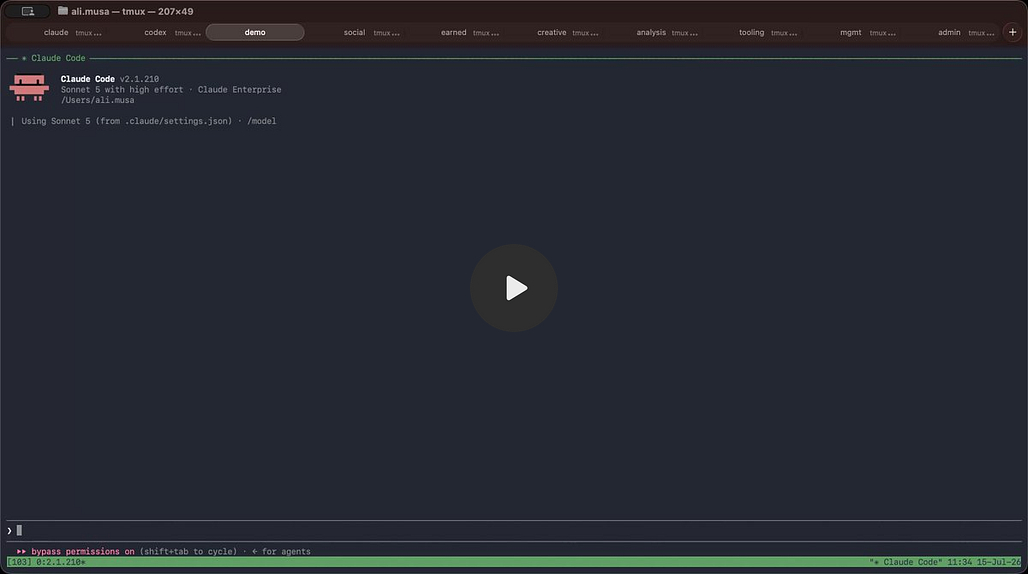
(4) Build apps with AI, Don’t hire humans, make AI UGC, make $$$


Some examples of how the average American feels
(1) How AI reacts to a simple request
As I was writing this newsletter, some of my family were sharing this video and laughing. This is how the average person feels about AI.
(2) AI trying to solve CAPTCHA
Very funny - worth a watch.
(3) DAY 22 of asking AI to count to 100
At one end of the spectrum, people expect AGI this year, while others are still trying to get it to count to 200.
The AI optimism gap is big & measurable.
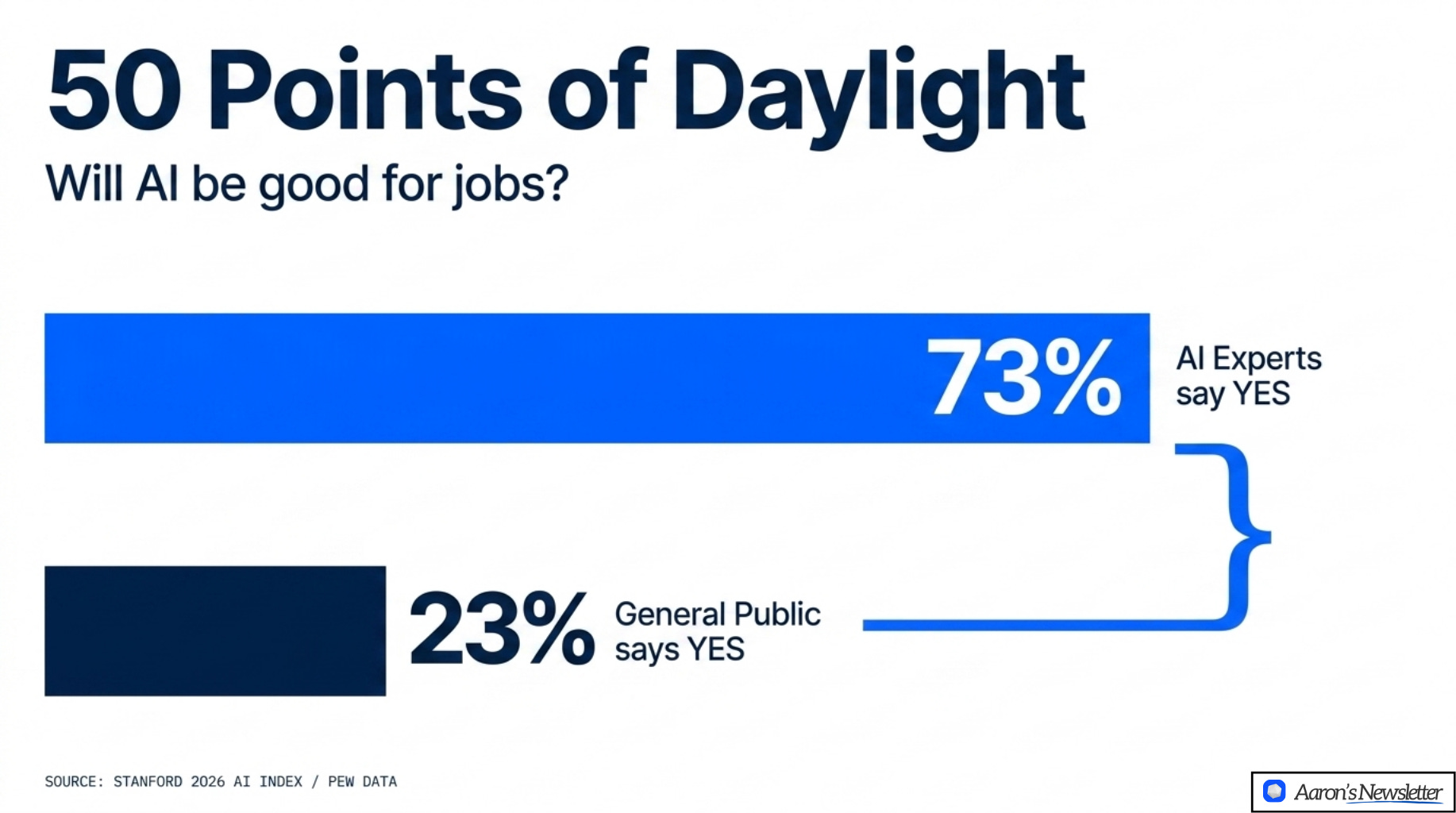
Stanford’s 2026 AI Index report, citing Pew survey data, lays out the divide in stark numbers. Ask whether AI will be good for jobs, and 73% of AI experts say yes. Among the general public, it’s 23%. Fifty points of daylight between the people building this and the people who have to live with it.
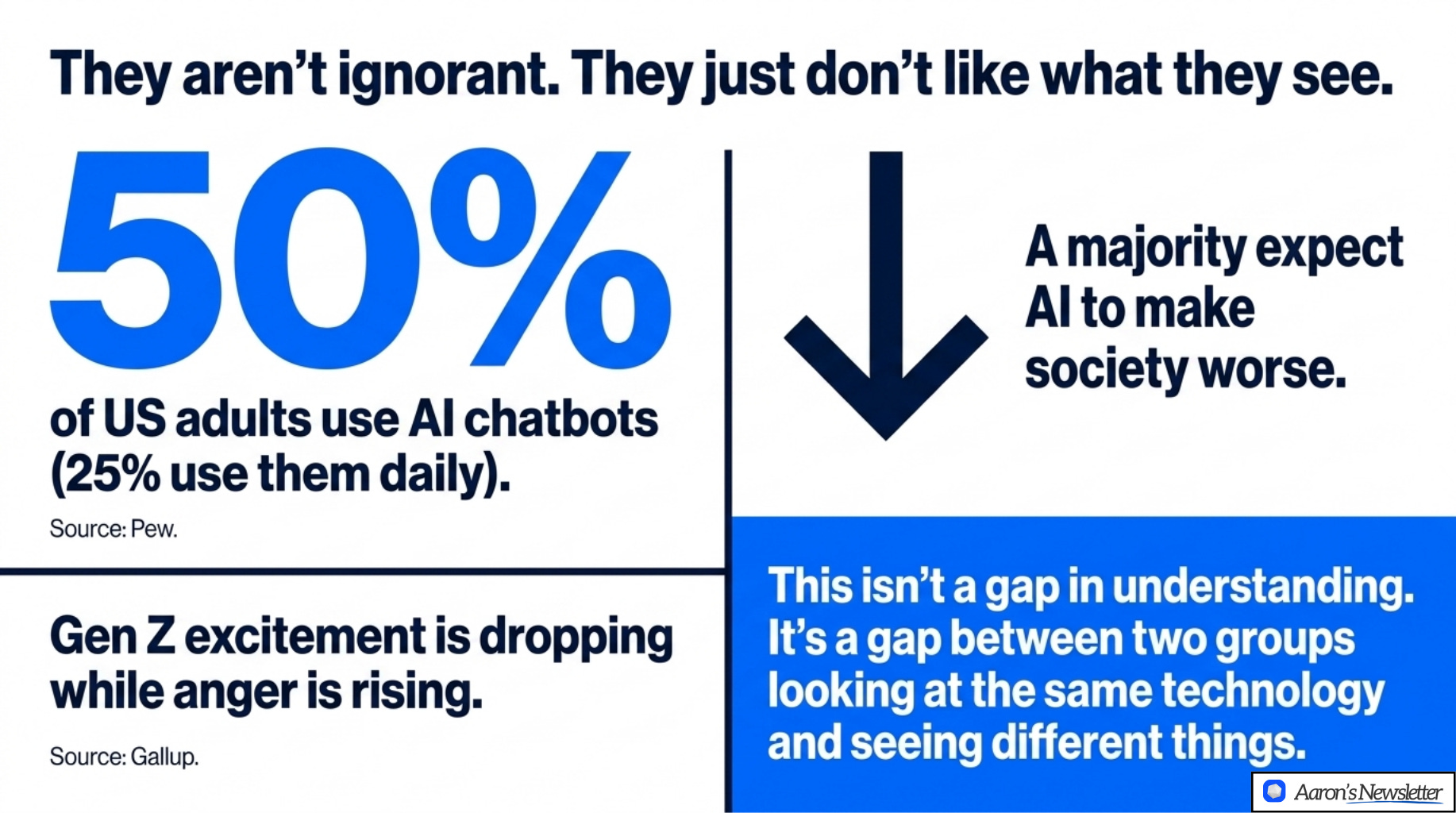
And the public isn’t ignorant of the technology. Pew found about half of American adults now use AI chatbots, a quarter of them daily. They’ve tried it. They’re using it. They still think it’s moving too fast, and more of them expect it to make society worse than better. Even Gen Z, supposedly the early adopters, is souring — Gallup found their excitement dropping and their anger rising.
Here’s the part the room gets wrong about those numbers. Inside the industry, that adoption curve reads as vindication — people are using it, so they must be coming around. But usage driven by resignation looks identical to usage driven by enthusiasm on a dashboard.
Pew’s own data show that people adopt a technology they expect will make society worse, often because they’re afraid of falling behind without it. The room is staring at proof of its success, which is actually evidence of the problem.
Contrary to what many in the industry say, this isn’t a gap between people who understand AI and those who don’t. It’s a gap between two groups looking at the same technology and seeing different things.
Which raises a real question: how does a room full of smart people keep cheering while everyone outside walks the other way? Is there something the industry is missing?
Why can’t the AI insiders hear the naysayers?
I don’t think it’s one thing, and I won’t pretend this is the complete list. But here are the five I keep running into, stacked on top of each other — and none of them requires anyone to be a villain.
(1) They’re using different software.
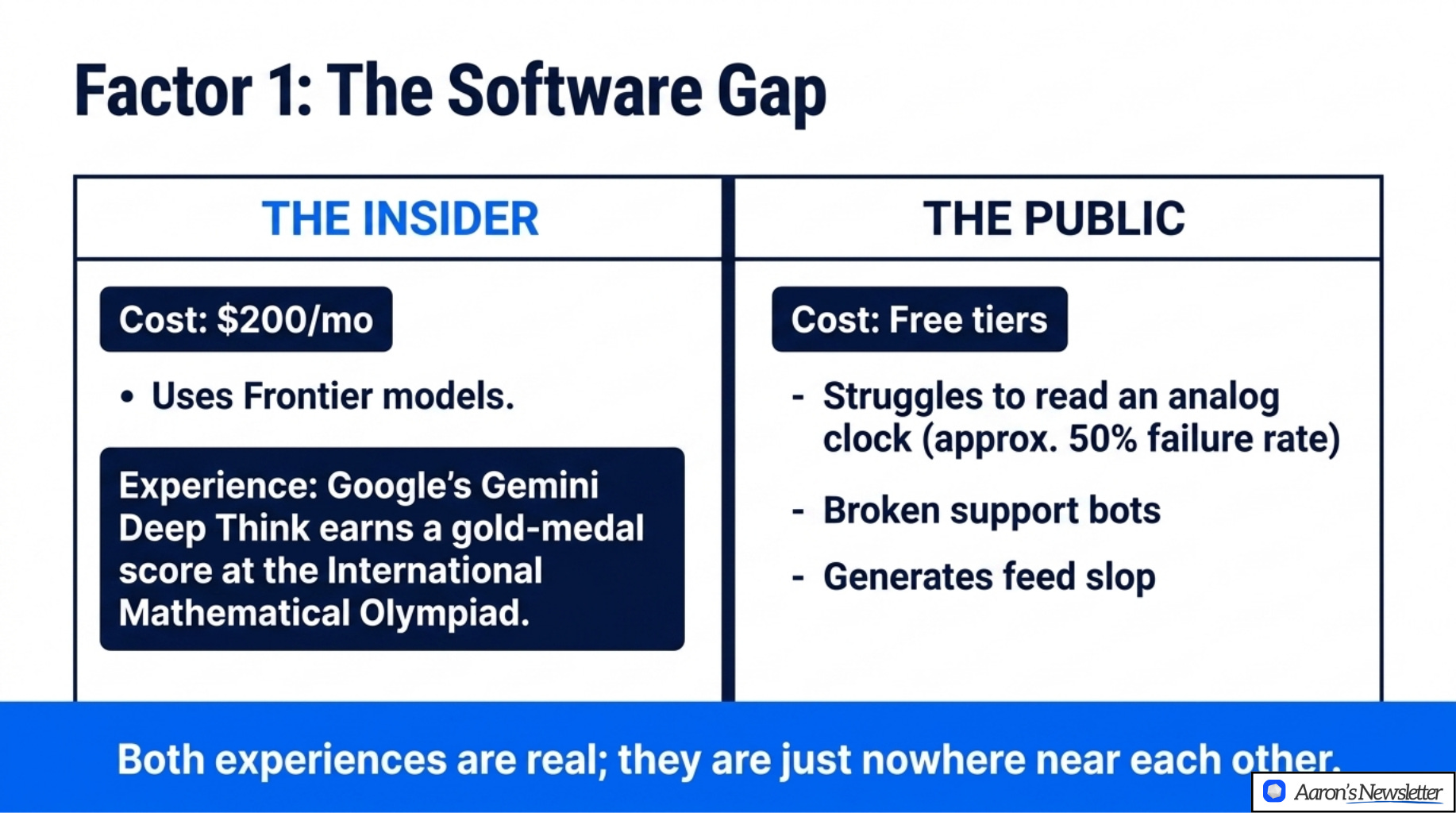
Andrej Karpathy made the point that someone paying $200 a month for a frontier coding model is basically using a different product than someone who tried a free chatbot to plan a wedding six months ago.
The insider’s daily experience genuinely is remarkable — per that same Stanford report, Google’s Gemini Deep Think earned a gold-medal score at the International Mathematical Olympiad. The same class of model reads an analog clock correctly about half the time.
The power user meets the gold medalist. Everyone else meets the broken support bot and the slop in their feed. Both experiences are real. They’re just nowhere near each other.
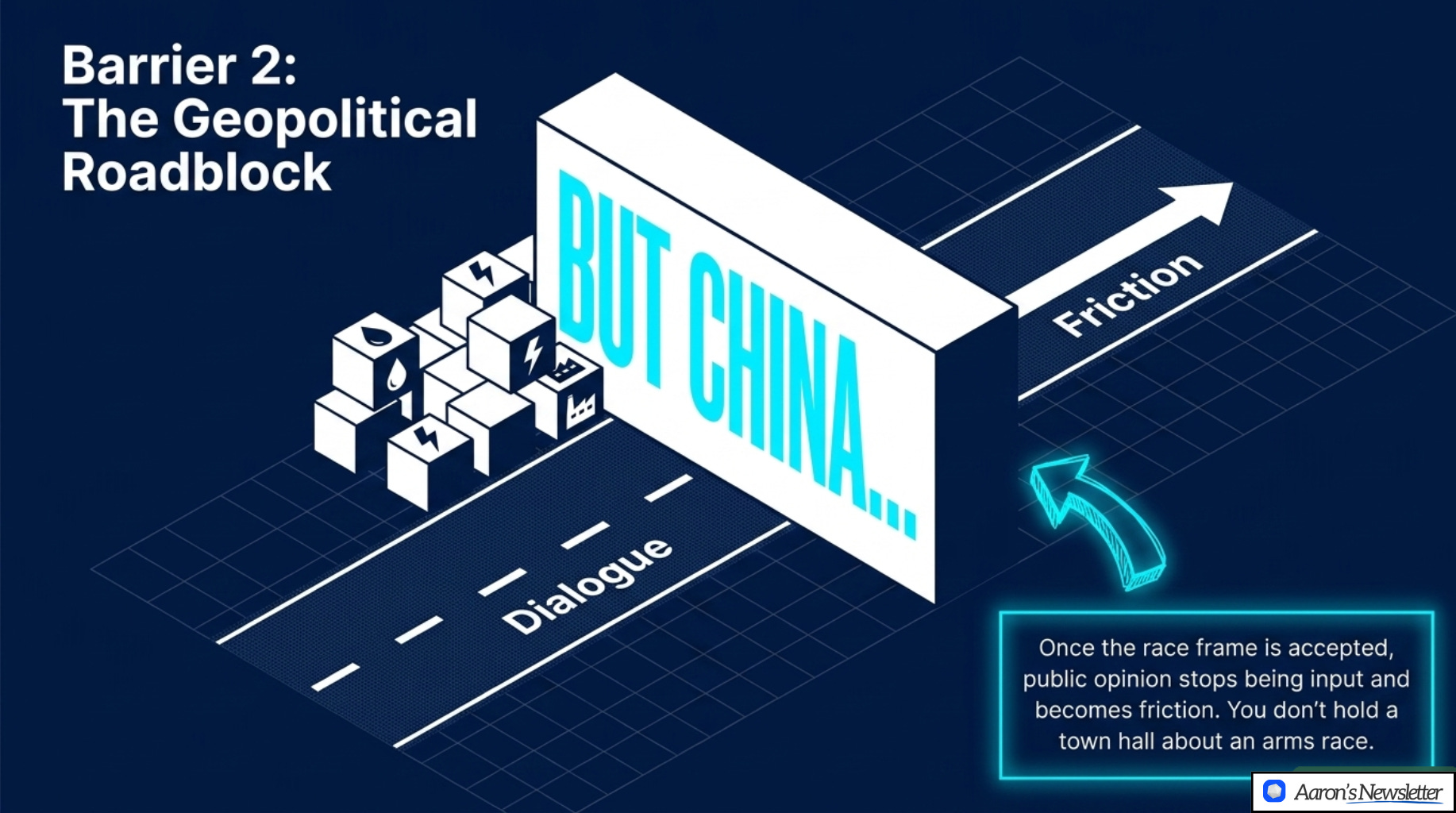
(2) “If we don’t build it, China will.”
The room’s trump card, and the one you hear most once every other argument runs out. It has real substance — the competition is not imaginary — but notice what the argument does in a conversation: it never has to engage the concern in front of it. Someone raises their water supply, their power bill, their job, and the answer is Beijing.
Once the race frame is accepted, public opinion stops being input and becomes friction, because you don’t hold a town hall about an arms race. The move works so well precisely because it’s partly true, which is what makes it such an effective permission slip to stop listening.
(3) The room filters out doubt.
Nobody skeptical stays in the group chat. The feed rewards the boldest claim, dissent reads as not getting it, and the doubters quietly leave. What’s left isn’t a sample of informed opinion — it’s a survivorship artifact. The volume stays at eleven because everyone at seven already walked out.
(4) The costs are invisible from the inside.
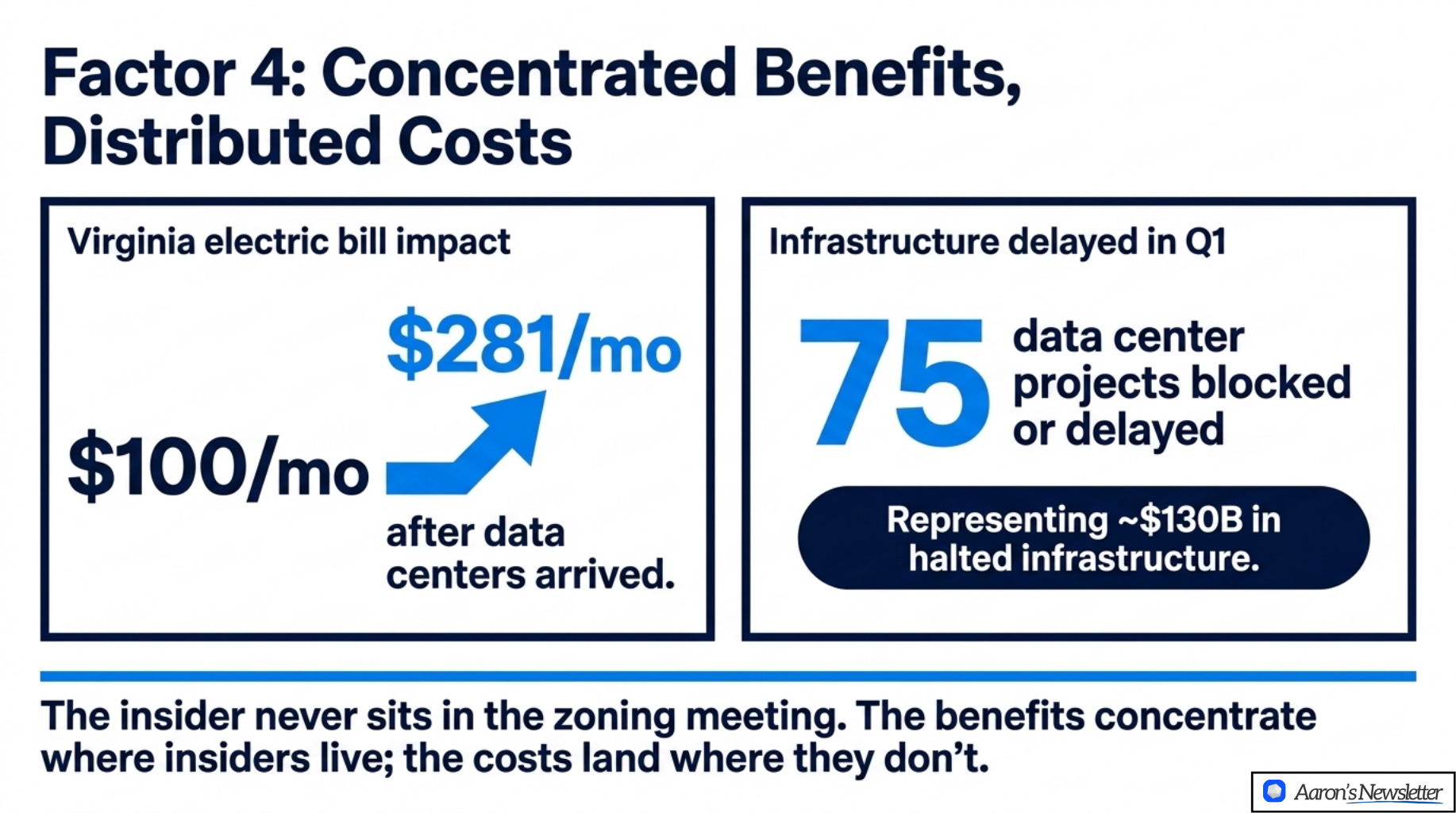
The insider never saw the electric bill in Virginia that went from about $100 a month to $281 after the data centers moved in. Never sits in the zoning meeting — and there have been a lot of those; local opposition blocked or delayed some 75 data center projects worth around $130 billion in the first quarter of this year alone. Never gets laid off and told to reskill. The benefits of AI concentrate where the insiders live. The costs land where they don’t. They haven’t weighed the public’s concerns and rejected them. The concerns just never appear in their field of view.
(5) Concerns arrive in the wrong vocabulary.
When someone says “AI is stealing artists’ work,” the room’s reflex is to correct the technical framing — that’s not how training works, actually — instead of hearing the grievance underneath.
Legitimacy gets gatekept by fluency: if you can’t phrase your worry in the room’s language, it doesn’t count as an objection, just a misunderstanding to be corrected. The person walks away having been told their concern was wrong on a technicality. The room walks away having answered nothing.
Any one of these is forgivable.
Stacked together, they create a room that structurally cannot hear anyone outside. Different software makes the insiders sincere. Incentives make them motivated. Selection makes them unanimous. Invisible costs make them confident. Fluency decides which complaints even count.
And the race with China makes it all feel too urgent to stop and listen.
What the general public actually thinks
Meanwhile, outside the room, two things are happening in layers.
The surface layer is fatigued. AI is bolted onto every product, whether it helps or not. Every keynote is revolutionary.
After two years at full volume, tuning out is more self-defense than anything. When roughly two-thirds of people say AI is moving too fast, some of that is about the technology. A lot of it is about the constant pitch.
But, underneath the fatigue, I think there is something heavier going on. I believe many suspect that this AI isn’t being built for people like them.
That it was trained on the public’s work, runs on the public’s water and power, and exists mainly to make a small group of already-wealthy people wealthier — possibly at the cost of everyone else’s livelihood.
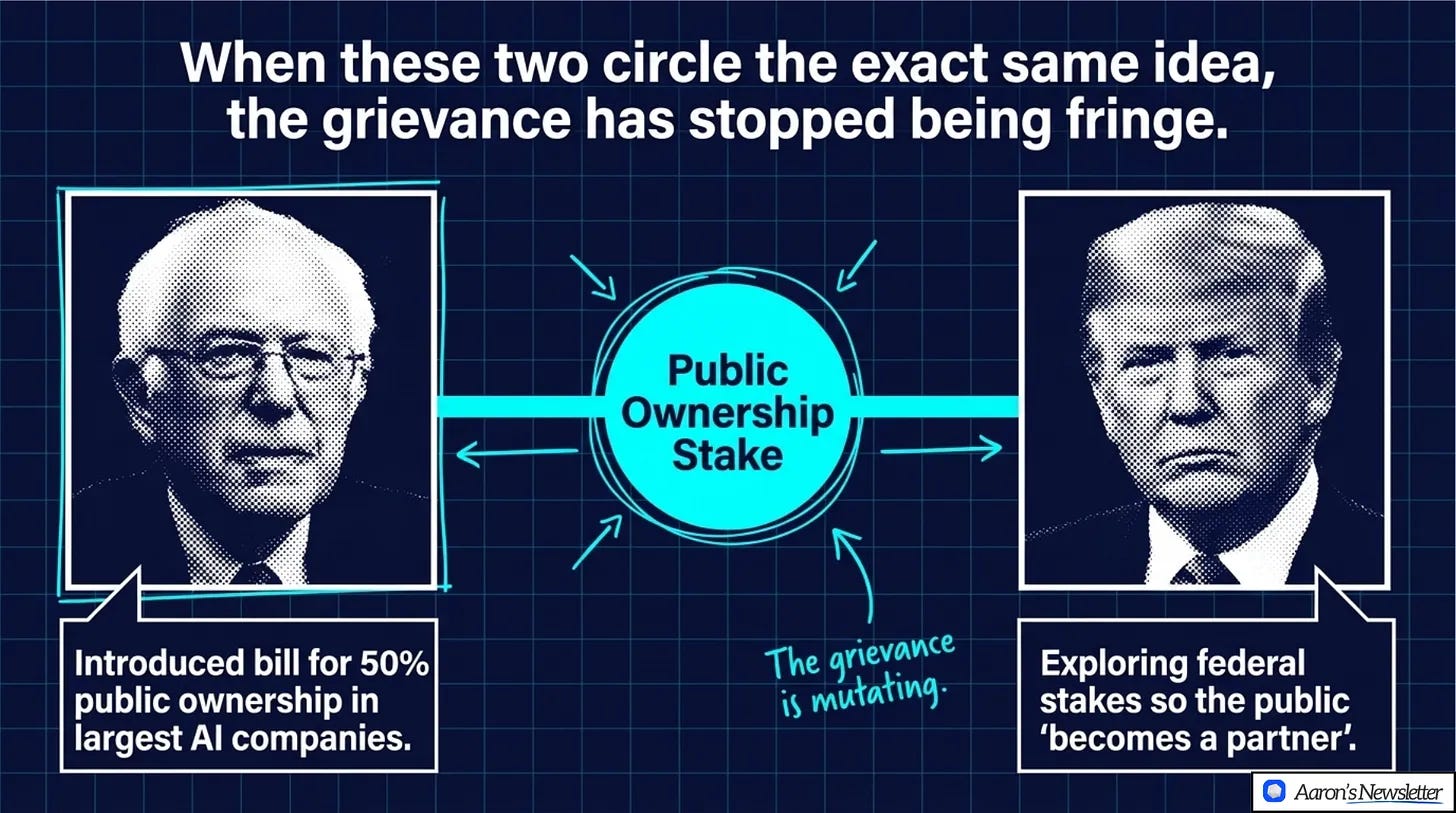
You can tell how mainstream that suspicion has gotten by who’s responding to it: Bernie Sanders has introduced a bill to give the public a 50% ownership stake in the largest AI companies, and Donald Trump has told reporters he’s exploring federal stakes in AI firms so the American public “essentially becomes a partner.”
When those two circle the same idea, the grievance underneath it has stopped being fringe.
.
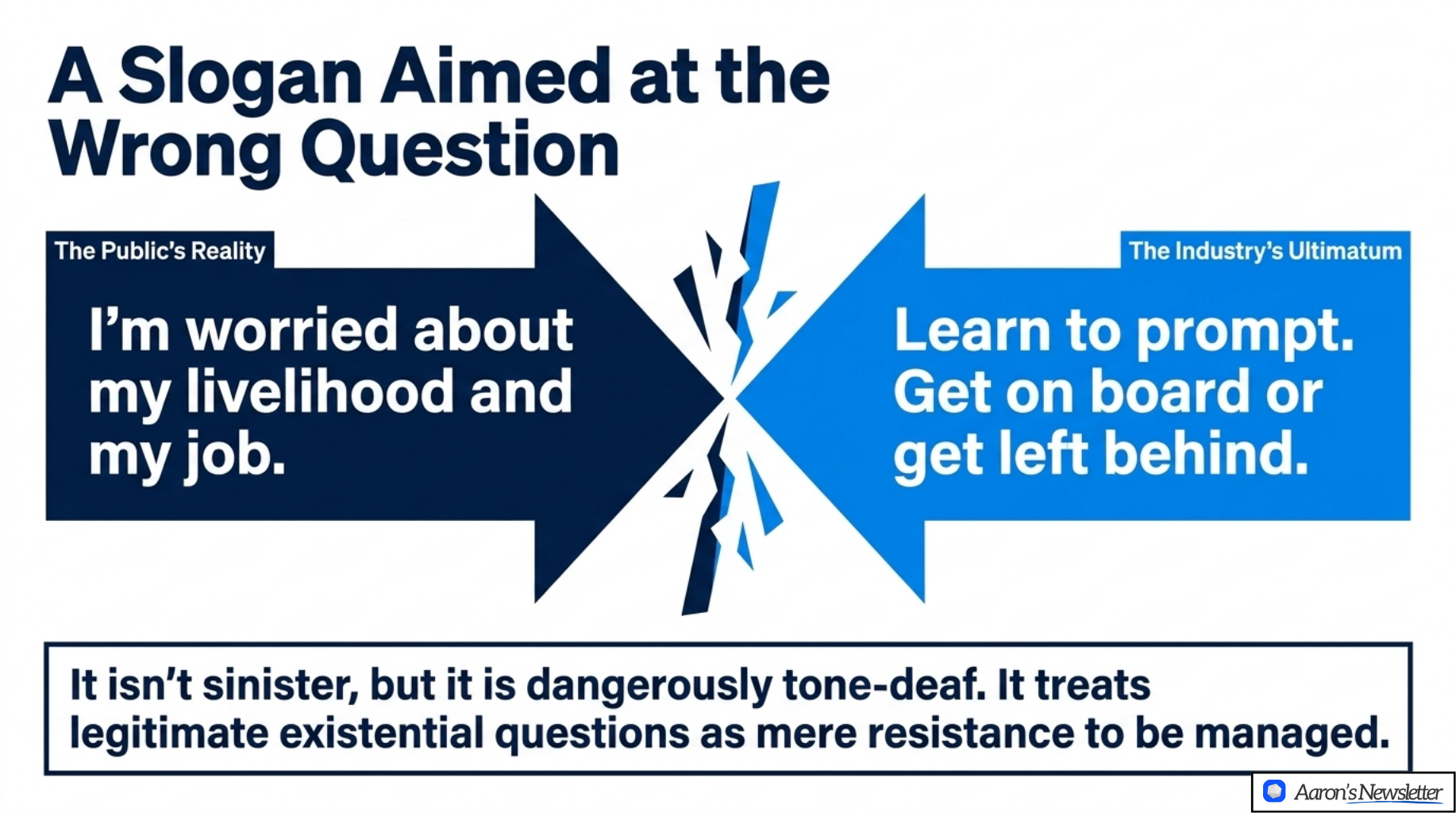
And the industry’s answer to all of this has mostly been an ultimatum… get on board or get left behind.
Someone says “I’m worried about my job,” and the room says “learn to prompt.” That’s not an answer. That’s a slogan aimed at the wrong question.
Meet people where they are
The fix for the echo chamber was never louder hype, nor is it nicer messaging. It’s substance — things people can feel in their own lives.
Power bills that go down, not up.
A straight answer about what a data center costs the town next to it.
Products that fix a real problem before adding a chatbot to a toaster.
Taking “what happens to my work?” seriously as a question, instead of treating it as resistance to be managed.
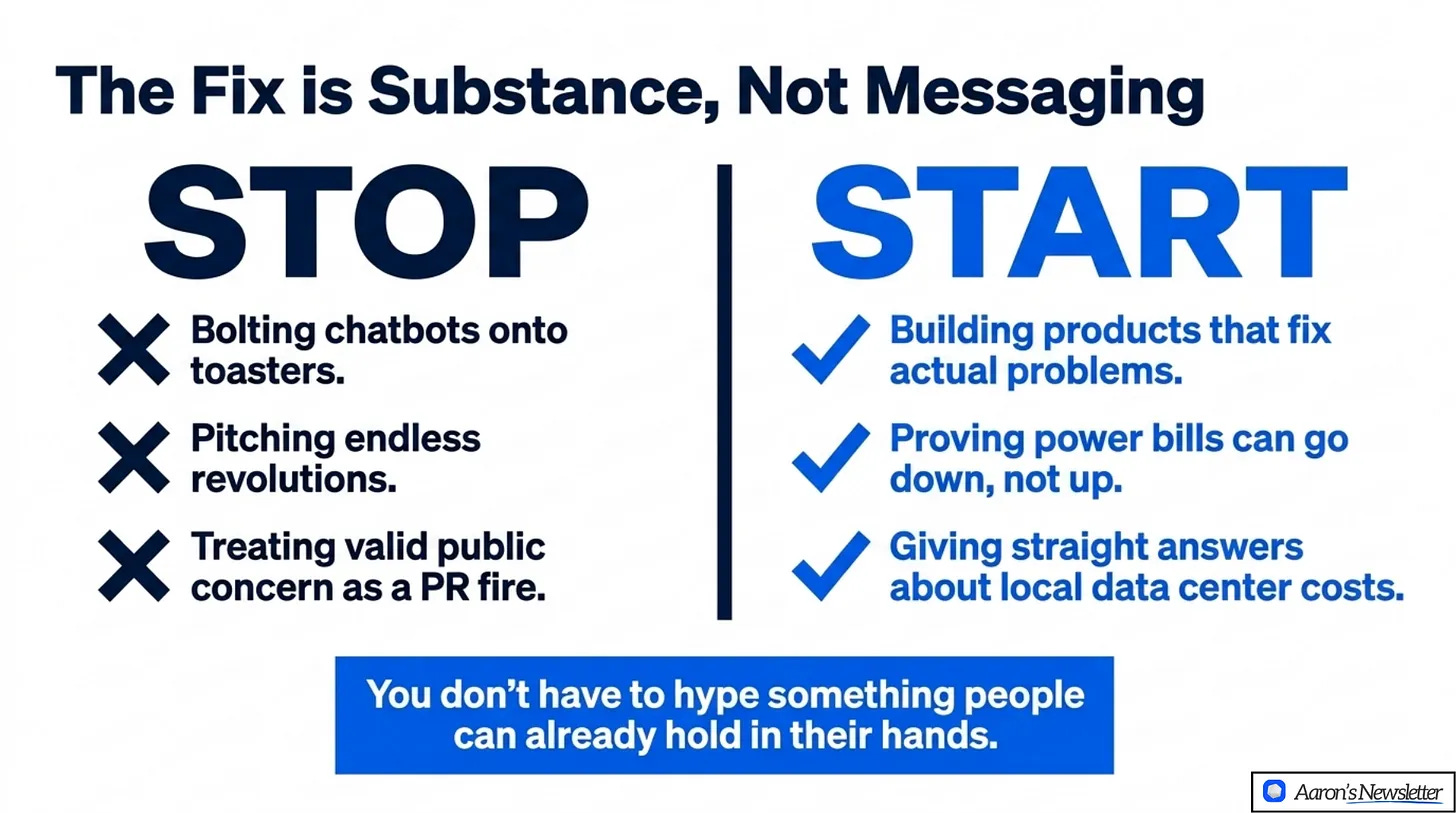
The people outside the ‘AI hype echo chamber’ aren’t confused about AI. They’re waiting for it to do something for THEM, and mostly it hasn’t yet.
When it does, the hype won’t be necessary, because you don’t have to hype something people can already hold in their hands.
More from me:
Learn how to pitch a business the fun way.
Get Products: The Card Game: Get my game where ‘Shark Tank’ meets Apples to Apples.
Wanting to stay ahead in search? Get Pluto - my FREE AI Visibility Chrome extension
Pluto - The Free AI Visibility Extension: I wanted a simple way, right inside the browser, to see: “If an AI model or search engine reads this page, what does it actually see?”
Share the newsletter and get rewards
Refer friends for rewards: Get cool rewards (like my card game) when you refer people to my newsletter. Check out where you stand on the leaderboard.