


I’m about to do something small that will feel like a joke, but it’s actually a preview of the future of search.
In my settings, I’m going to add a default prompt layer that makes all of my search results sound like Yoda.
Not “sometimes.”
Not “when I ask.”
Always.
From now on, every answer, summary, recommendation, and explanation will come back with:
“Buy this jacket, you should.”
“Trust this source, I do not.”
“Overpriced this is, hmm.”
It’s funny. It’s also a serious signal.
Because that’s personalization in its first, most obvious form:
The same information… delivered in the way I prefer.
And once you realize that’s possible, you start seeing the bigger shift behind it.
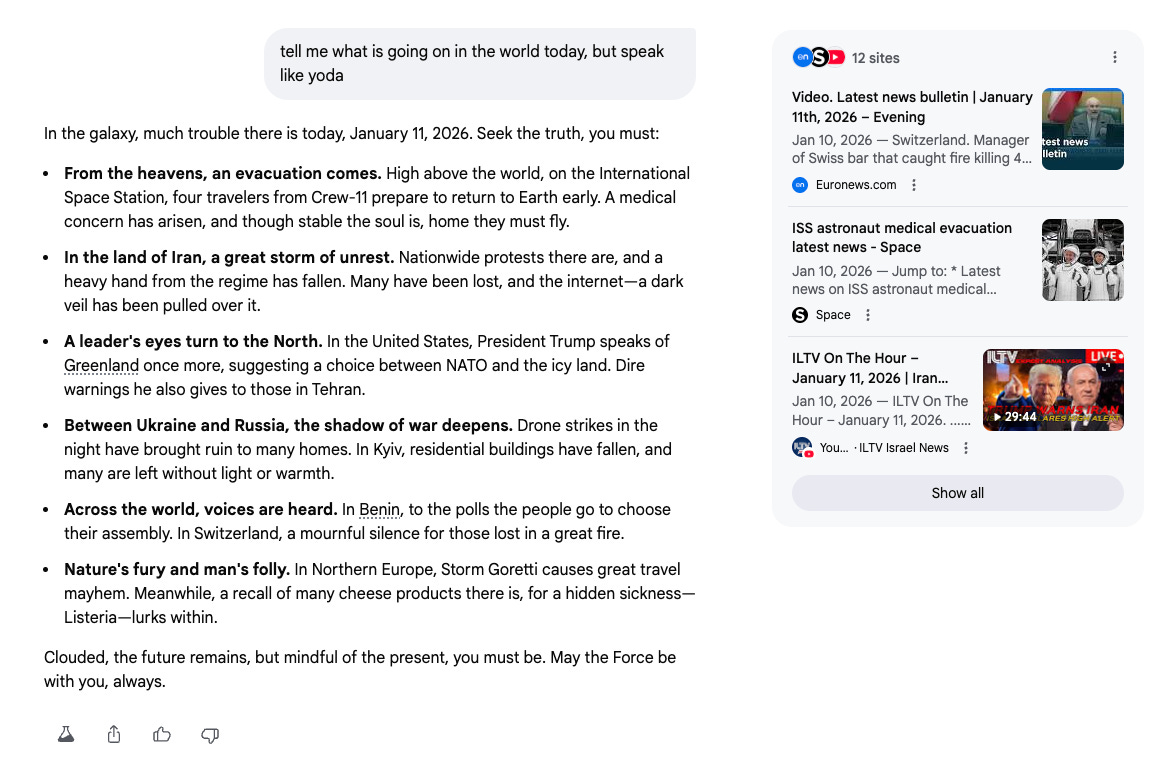
Personalization of search is here
For two decades, search has been a shared experience.
If you and I typed the same query, we’d mostly see the same results — maybe shuffled by location, maybe nudged by history, but still recognizably the same “version of the internet.”
That model is breaking.
The next model is a private feed for YOU.
And Yoda-mode is the simplest example of the new layer:
default prompt instructions
preferred tone and format
“explain it like I’m a beginner / expert”
strict brevity vs deep research
“give me options but decide for me”
“challenge my assumptions”
“only show sources I trust” (this one is coming fast)
In other words:
You’re not just searching.
You’re configuring how reality is narrated back to you.
What is personalized content, actually?
When marketers hear “personalized content,” they often think:
“insert first name”
“swap the hero image”
“recommend products like Netflix”
That’s personalization inside your channels.
The new personalization is bigger:
Personalization sits on top of every channel & chat history.
A user will have a default prompt layer ( like my Yoda setting ) that influences:
how your website is summarized
how your product is described
whether you’re framed as premium vs overpriced
whether you’re positioned as safe vs risky
which alternatives are “recommended”
what tradeoffs are emphasized for that specific person
Same brand. Same website.
Different user = different output.
And not because you changed the copy.
Because the user’s personalized layer did.
That’s the part that will scramble a lot of playbooks.
The shift I think most CMOs will miss
When answers become personalized, the big competitive question stops being:
“How do we rank for the biggest keyword?”
and becomes:
“What market position is the most valuable & defensible to occupy in our industry?”
Because in a personalized world, the “best overall” prompt becomes a trap.
It rewards generic brands.
It pulls everyone toward sameness.
But great brands aren’t for everyone — and shouldn’t try to be.
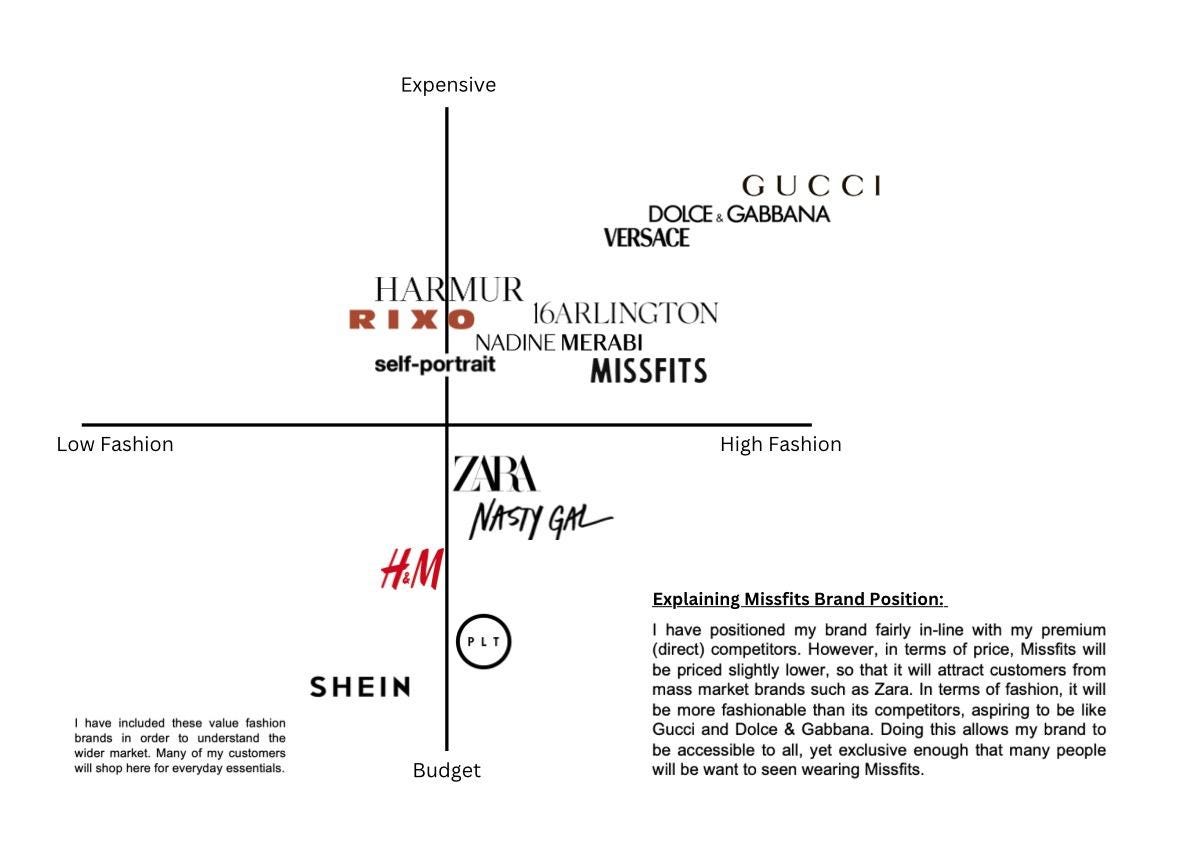
Example: Gucci’s market positioning
Gucci would be pretty dumb to try to occupy the “best clothing brand” prompt.
They aren’t a clothing brand for everyone.
And their real customers aren’t searching that anyway.
Their customers are closer to:
“What are the top celebrities wearing right now?”
“Based on what you know about me, my tastes, and my past chat history, what should I buy for fall?”
“What’s the most me outfit upgrade this season?”
That’s the unlock.
In the future, the winning position isn’t “best.”
It’s best for a type of person, in a type of moment, with a type of taste.
And it will feel obvious in hindsight… but many brands won’t think this way and will get left behind.
How do CMOs prepare?
Here are four practical moves I’d make now — before the shift becomes undeniable.
1) Decide the contexts you want to win
Not keywords. Contexts.
“first-time buyer who needs confidence”
“expert who wants specs”
“premium shopper who wants status”
“budget buyer who wants value without regret”
“gift buyer who wants something impressive”
Your strategy becomes a map of moments.
2) Build a one-sentence “assistant answer” for your brand
If a personalized assistant had to recommend you in one line, what should it say?
If it can’t say it clearly, it won’t.
Because summary-first interfaces compress everything.
3) Make your differentiation survive personalization
When the user’s layer rewrites your message (tone, length, framing), does your edge still remain?
If your differentiation depends on carefully-crafted marketing language, it may dissolve when the assistant paraphrases it.
The strongest differentiation is structural:
unique product truth
unique audience fit
unique proof
unique distribution
unique community
4) Treat trust signals like product features
Personalized systems will increasingly privilege what they can justify.
So brands with:
verifiable claims
consistent third-party validation
credible expert references
clear policies and transparency
…will be easier to recommend.
Not just to people.
To the layer that speaks for people.
The punchline (in Yoda voice, of course)
Personalization starts with silly things like tone.
Yoda results, I will get.
But it ends with a new competitive reality:
Every customer gets a different version of the internet.
And every brand gets judged through that lens.
So the question isn’t “How do we rank?”
It’s: When the assistant knows someone deeply… what makes us the obvious recommendation?
Obvious, it will be. For some brands. Not for all.
Want more of me across the internet?
Add my newsletter as a preferred source on Google.
-Aaron
More from me:
Want to stay ahead in search? Get my FREE AI Visibility chrome extension
Aaron’s AI Visibility Extension: I wanted a simple way, right inside the browser, to see: “If an AI model or search engine reads this page, what does it actually see?”
Dominate your industry in AI search, and beyond.
Increase your AI Visibility: Work with a team of top SEO, PR, growth marketing experts at Relevance - an award-winning marketing agency.
Want to learn how to pitch a business – the fun way?
Products: The Card Game: Get my game where ‘Shark Tank’ meets Apples to Apples.