


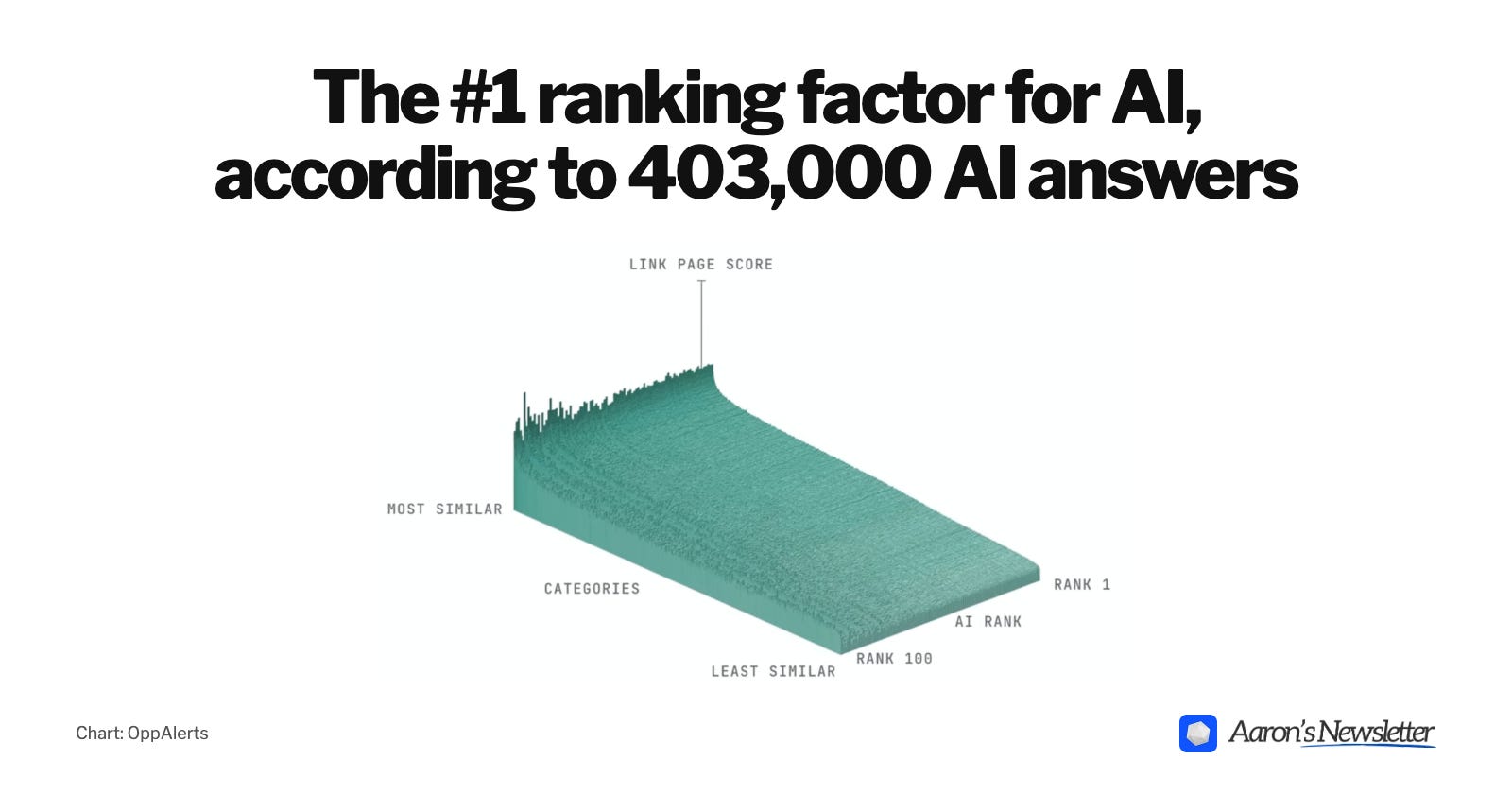
ChatGPT doesn’t know how many backlinks your website has. It doesn’t check. It never has.
So why do so many marketers still treat backlinks like the key to showing up in AI?
This week, Ben Wills, founder of OppAlerts, published one of the biggest studies I’ve ever seen on how AI decides who to recommend. His LinkedIn post announcing it opened with a big claim: we “finally know the #1 ranking factor for AI.”
Normally, when I see “#1 ranking factor” on LinkedIn, I keep scrolling. Every week, it seems like there’s another secret trick to get into ChatGPT, usually attached to a course.
But this one is backed by real data, at a scale I haven’t seen before.
So, this whole newsletter comes down to two big questions:
What actually gets a business recommended by AI?
Can a small business do anything about it?
Here’s the short answer up front.
The #1 factor is… being on the pages that appear at the top of search results for your industry’s questions.
Think a “Best CRM for small businesses” article that links to HubSpot. Or a “Top roofers in Kansas City” list that names a local contractor.
AI isn’t analyzing your website’s link profile. It’s reading what shows up in search. If you’re on those pages, or you’re ranking yourself, you show up in AI as a result.
Everything else, including the authority scores and link counts agencies sell, mattered far less.
To be fair, this isn’t a shocking discovery. Most SEOs I know have long assumed brand mentions were a top tactic. But assuming something and proving it at this scale are two different things, and I haven’t seen many studies like this one.
How big is this study, really?
Most of the “AI search” advice I see is based on a handful of screenshots. Someone asks ChatGPT a question, their client shows up, and suddenly there’s a framework.
The problem is that AI gives slightly different answers every time you ask. One screenshot tells you almost nothing.
Ben’s study goes about as far in the other direction as I’ve seen.
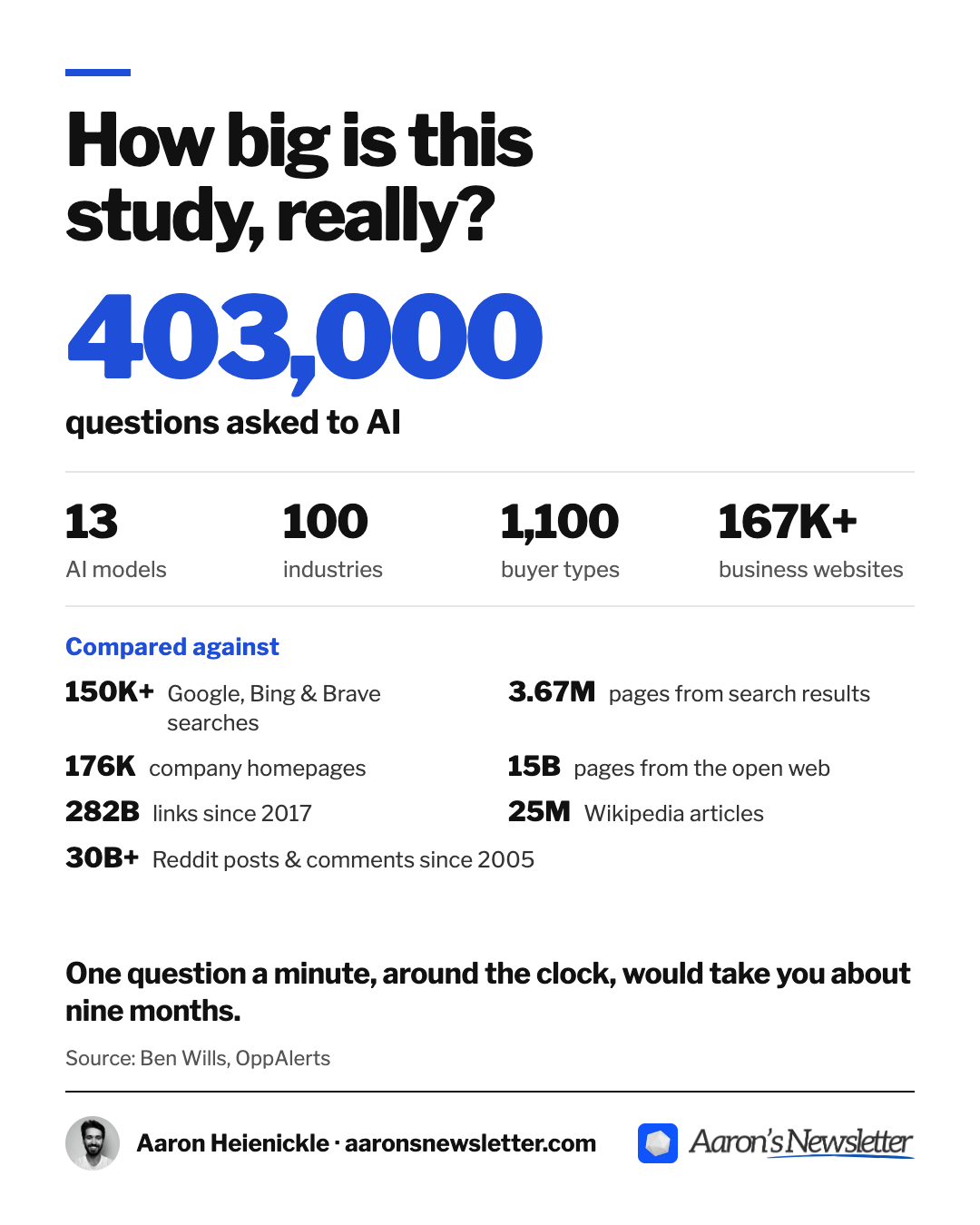
He started with 500 possible industries and narrowed it to the 100 that had enough data to study properly. Then for each industry, he created 11 different types of buyers, like a small business owner shopping for payroll versus an enterprise HR director. That’s 1,100 buyer types in total.
Then he asked AI who to go with. Over and over.
403,000 questions across 13 AI models, including ChatGPT, Claude, Gemini, and DeepSeek.
To put that in perspective, if you typed one question into ChatGPT every minute, around the clock, with no sleep, it would take you about nine months to get through them all.
That’s just the AI side. To figure out why certain businesses got recommended, he compared those answers against a mountain of other data:
(1) 150,000+ Google, Bing, and Brave searches, recording who showed up and where
(2) 3.67 million web pages from those search results, checked for who they link to
(3) 176,000 company homepages, checked for what words they use
(4) 15 billion web pages from the open web
(5) 282 billion links between websites, going back to 2017
(6) Every Reddit post and comment since 2005, about 3.7 billion posts and 26.6 billion comments
(7) 25 million Wikipedia articles
All told, the study looked at over 167,000 different businesses’ websites.
Why does that matter to you?
Because at this size, flukes wash out. One weird answer from ChatGPT doesn’t move the needle when there are 400,000 others. If a pattern shows up across 100 industries and 1,100 types of buyers, it’s probably not luck.
But here’s the part I want to be honest about.
A big dataset makes a pattern more believable. It doesn’t prove what’s causing it. Billions of data points can still show you two things moving together without telling you which one is pushing the other.
I’ll come back to that. First, the results.
What the study found.
Quick definitions first, because SEO people throw these words around a lot:
A backlink is a link from another website to yours.
Domain authority is a score for how big and established a website is, mostly based on how many backlinks it has.
For twenty years, the SEO playbook has been to get as many backlinks as possible from the highest-authority sites. Agencies price their work around these scores.
Here’s how the signals ranked in the study, strongest first:
(1) Getting linked from pages that already show up in search for your industry’s questions
(2) Your homepage using the same words your customers use
(3) Your overall domain authority
(4) Your raw number of backlinks
(5) Being cited on Wikipedia, which came in dead last out of all 18 signals
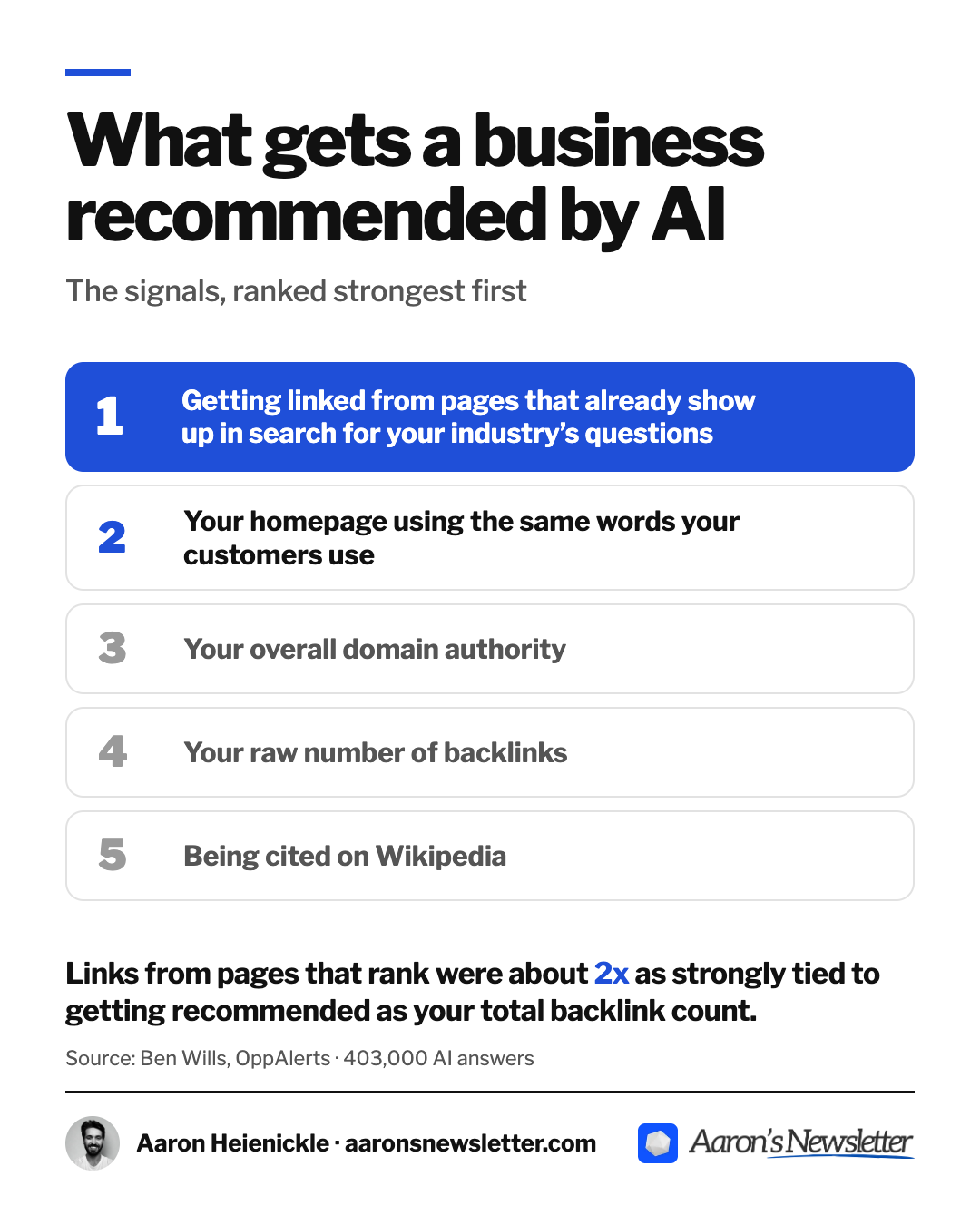
Links from those pages that rank in search were about twice as strongly tied to getting recommended as your total backlink count.
And according to Ben, the same pattern held for brand mentions with no link at all. Your name just sitting on the right page counts.
I went through all 100 industries myself.
I didn’t want to just repeat the headline. So I went industry by industry and wrote down which signal came out on top in each one.
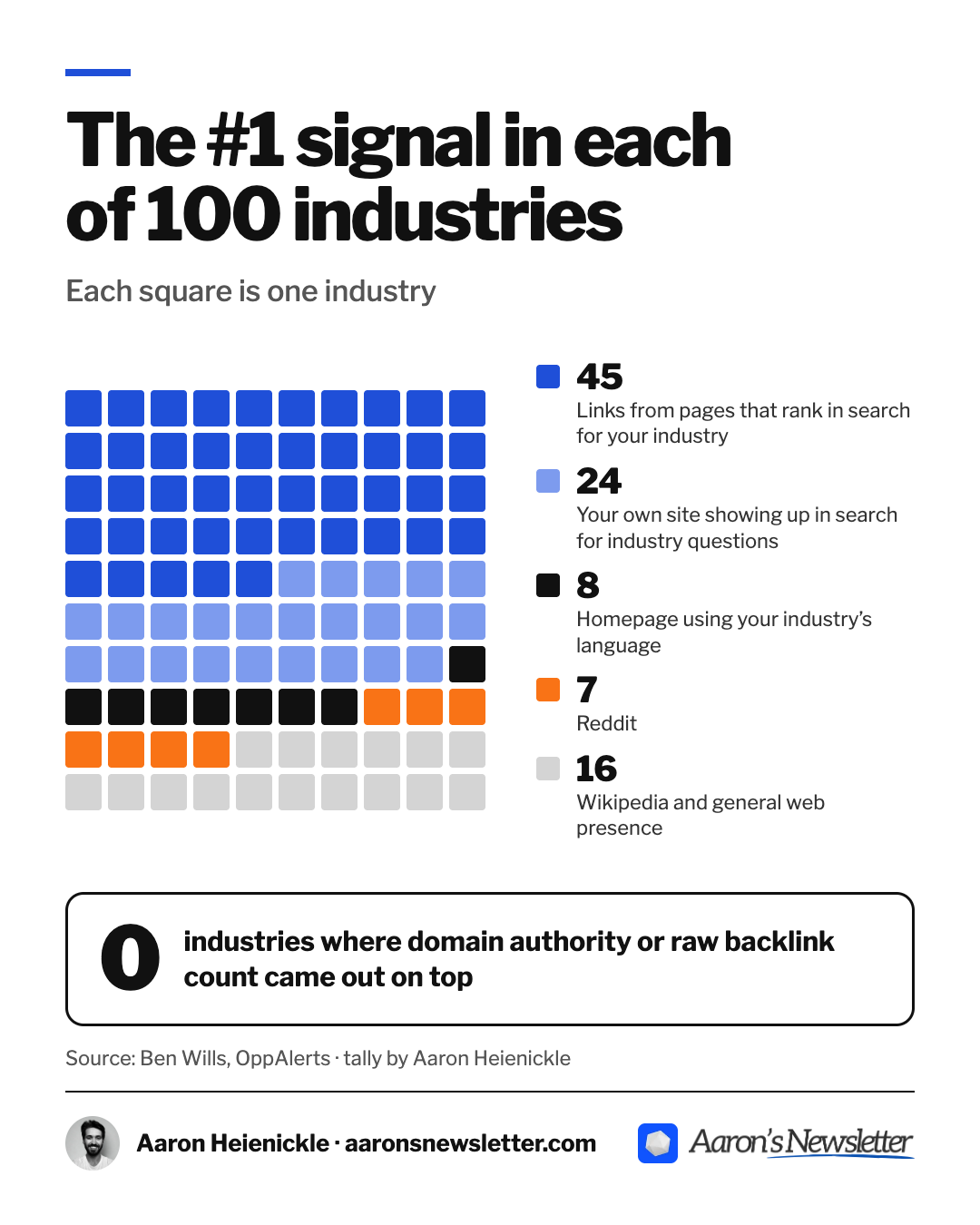
Links from pages that rank in search for your industry: #1 in 45 industries
Your own site showing up in search for industry questions: #1 in 24
Homepage using your industry’s language: #1 in 8
Reddit: #1 in 7
Wikipedia, Wikidata, and general web presence: the remaining 16
And domain authority or raw backlink count?
Zero.
Not one industry.
Meanwhile, in 69 of the 100 industries, the top signal had to do with search results.
Why search is the front door to AI.
Most people picture ChatGPT as some all-knowing brain that weighs every business on the internet and picks the best one.
That’s not how it works.
AI ends up recommending a business through two different doors.
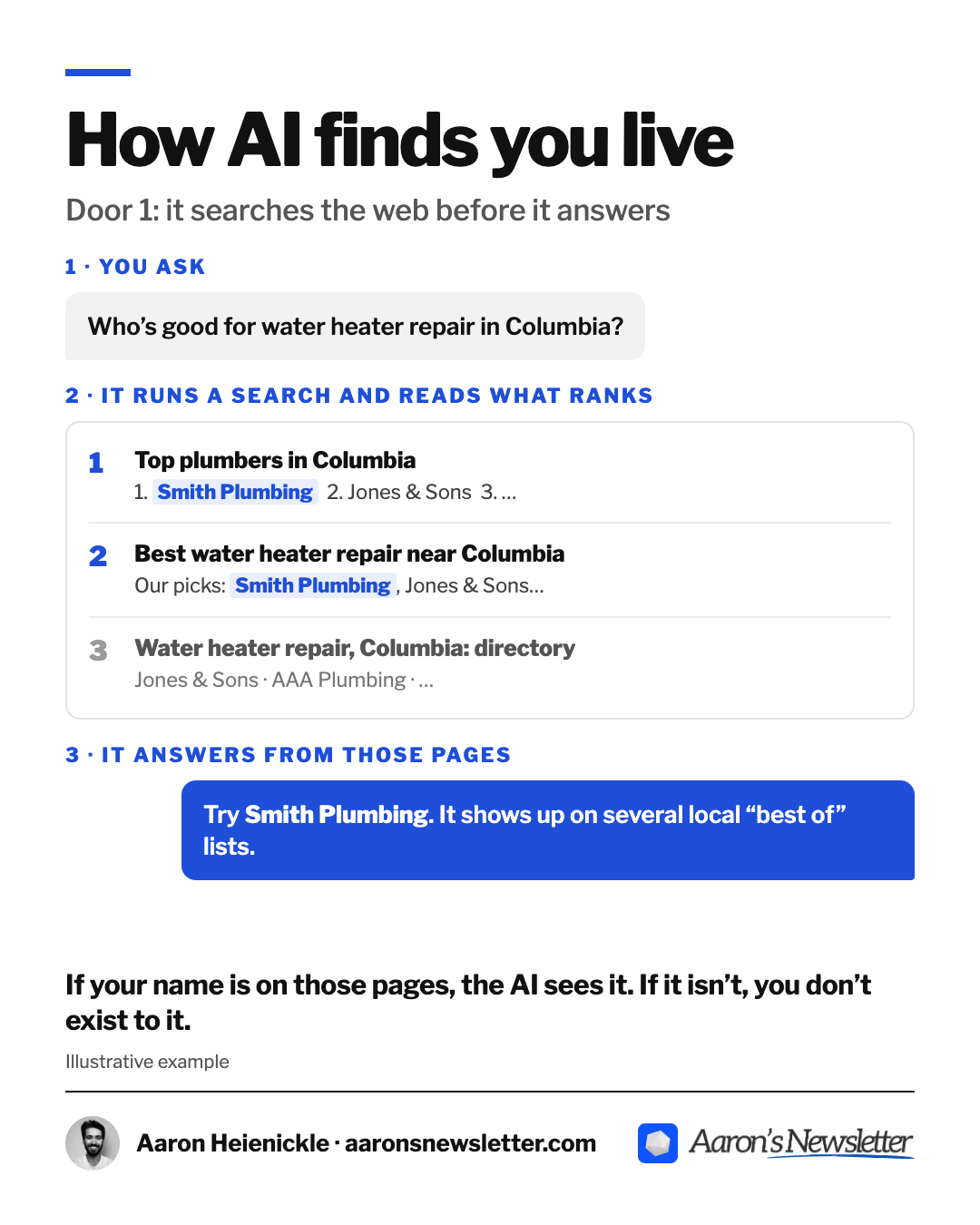
Door 1: It searches the web live.
ChatGPT, Gemini, Claude, and Google’s AI Overviews often run a search before they answer. And what comes back? The pages ranking at the top.
This is where ranking really matters. If your name is on those pages, the AI sees it. If it isn’t, you don’t exist to it, no matter how good you are.
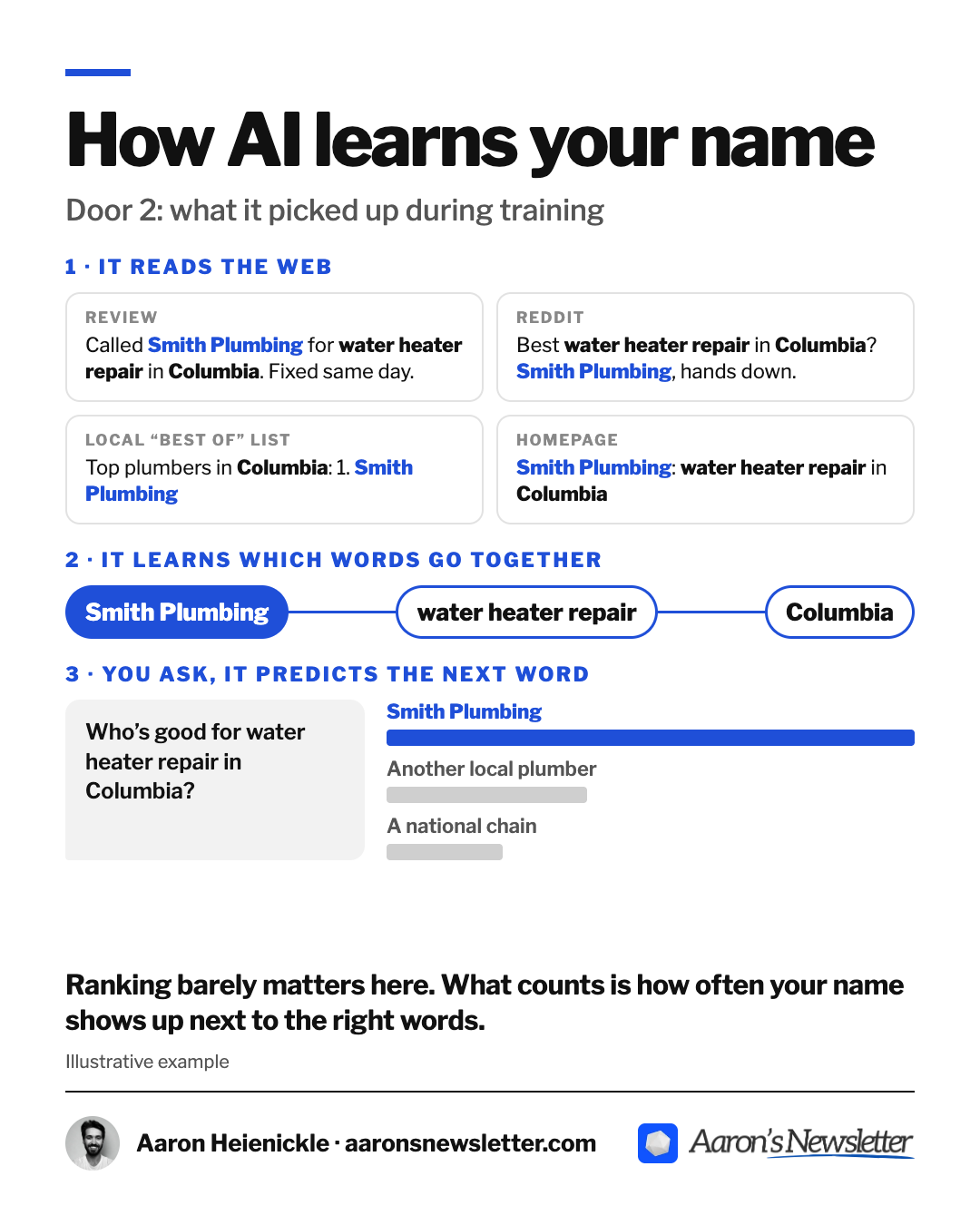
Door 2: It learned from the web during training.
When AI answers from memory, it isn’t looking anything up. It’s predicting the next word, based on patterns it picked up from reading a huge chunk of the internet.
So if “Smith Plumbing” appears again and again near words like “water heater repair” and “Columbia,” the AI learns those words go together. Ask it about water heater repair in Columbia, and Smith Plumbing becomes a likely next word.
Here, ranking barely matters. Your pages just need to be out there and readable by the crawlers that collect training data. What counts is how often your name shows up next to the right words, across as many places as possible.
That’s also why your homepage wording was the #2 signal. And why general web presence, basically how much of the open web mentions you, was the top signal in 7 industries.
So where do backlinks fit in?
They help you rank in search, which opens Door 1. That’s it. AI never looks at your backlink count. The link is two steps removed from the recommendation, which is why it showed up so weakly in the data.
Think of it like the best mechanic in a small town.
Door 1 is when someone asks around at the diner and hears his name. Door 2 is that his name has come up in so many conversations about trucks over the years that it’s the first one people think of.
Either way, nobody’s counting his business cards.
Most posts skip this part, but it’s important.
If AI is reading search results and learning from words, then the link itself isn’t the point. Your name on the page is.
That’s why Ben’s point about unlinked mentions matters. The AI isn’t clicking anything or counting links. It’s reading the page.
A mention of your business, on a page that ranks, next to the right words, does the work.
I can already see the threads coming. “Buy links on listicles. Here’s my course.”
That’s the old playbook with a new label on it.
It also means something a lot of people on LinkedIn won’t want to hear: SEO isn’t dead. Showing up in search is still the front door to showing up in AI.
Three reasons to hold the hype.
I’d be doing exactly what I complain about if I oversold this.
It shows a pattern, not proof. Popular brands land on “best of” lists because they’re already popular. Some of this probably runs backward.
It’s not the whole story. This is the strongest pattern in the study, but plenty of what drives AI recommendations is still unexplained. The pattern does get noticeably stronger when you look at one industry at a time.
Ben sells a tool for this. OppAlerts helps you find relevant mention and link opportunities. That doesn’t make the data wrong, and he published his methods openly. But you should know.
Still, the findings line up with how these models actually work. That’s more than most “ranking factor” posts can say.
What I recommend doing.
Here’s why I think this is good news for small businesses.
You can’t outspend a national brand on authority scores.
But you can become the most talked-about name in your corner of the internet.
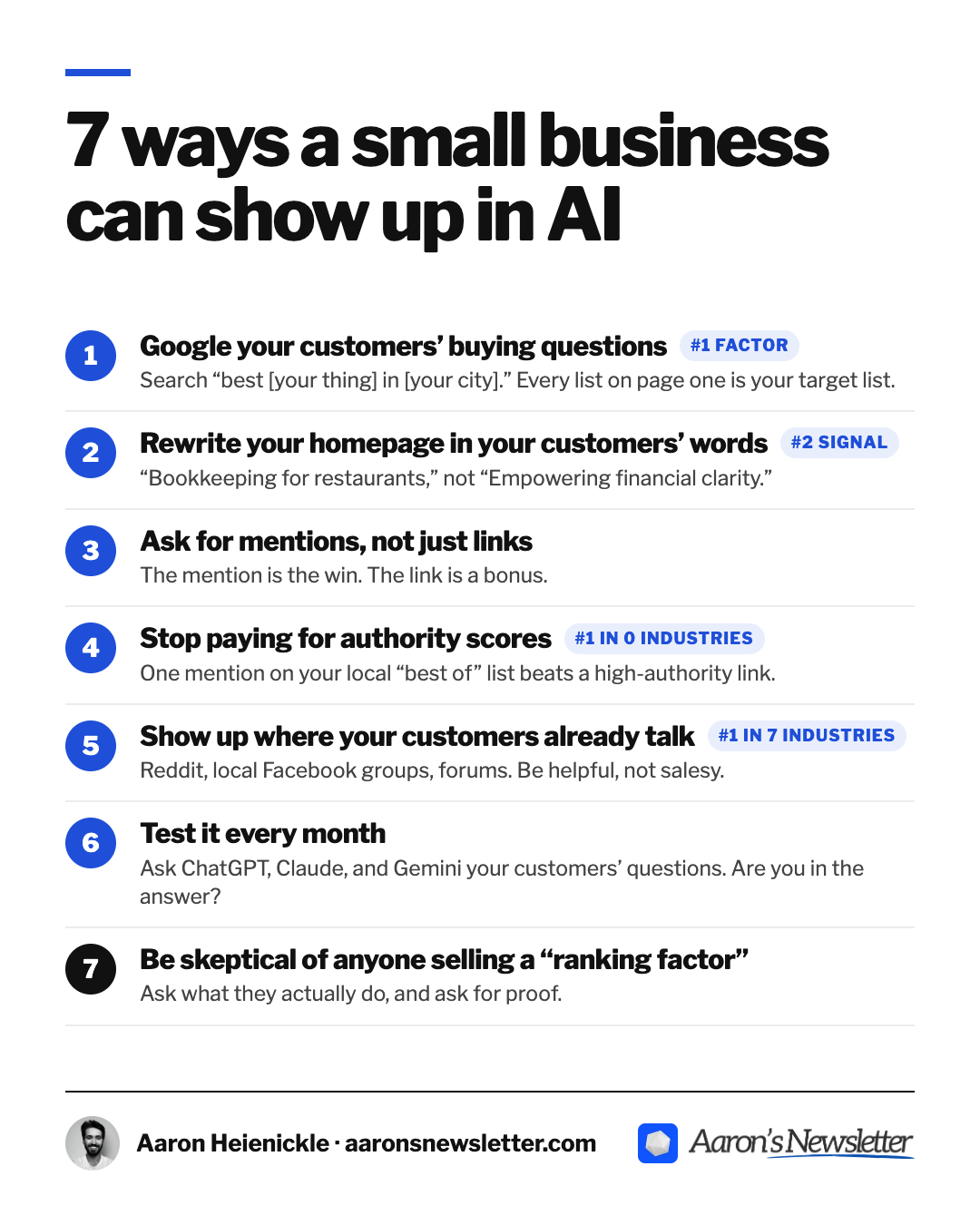
1. Google your customers’ buying questions.
Search “best [your thing] in [your city]” and “[your service] for [your type of customer].” Write down every list, roundup, directory, and comparison page on page one.
That’s your target list. Getting mentioned on those pages is the #1 factor in this study. And while you’re at it, note which of those searches your own site could realistically rank for. Your own site showing up in search was the top signal in 24 industries.
2. Rewrite your homepage in your customers’ words.
Say what you do, for who, plainly. “Bookkeeping for restaurants,” not “Empowering financial clarity.”
But, why? Homepage wording was the #2 signal overall and the top signal in 8 industries. It’s also the only signal on this list you fully control, today, for free. And it’s how you teach AI which words belong next to your name.
3. Ask for mentions, not just links.
When you pitch a local blog, a podcast, or an industry association, don’t make the link the deal-breaker. The mention is the win. The link is a bonus.
4. Stop paying for authority scores.
If an agency’s pitch is built around high-authority links or a link count, you now know those never came out on top in a single industry. One mention on your local “best of” list beats a high-authority link from a site that has nothing to do with your work.
5. Show up where your customers already talk.
Reddit was the top signal in 7 industries. Answer questions in your niche’s communities, local Facebook groups, and forums. Every helpful answer puts your name next to the right words, which is exactly what Door 2 runs on. Be helpful, not salesy. People can smell a pitch from a mile away, and so can moderators.
6. Test it every month.
Ask ChatGPT, Claude, and Gemini the questions your customers would ask. Are you in the answer? Who is? Then go find where they’re getting mentioned.
7. Be skeptical of anyone selling you a “ranking factor.”
I said this about the fake evil-AI market and the watermark scrubbers, and it applies here too. Over the next few months, you’ll see a flood of “AI SEO” packages. Ask what they actually do, and ask for proof.
Bringing it all together.
AI doesn’t keep a list of the biggest websites, and it doesn’t look at your backlinks. It either reads what ranks in search right now, or it leans on how often it’s seen your name next to the right words.
That’s why being on pages that rank for your industry was the strongest signal in the study. That’s why your homepage wording matters more than your authority score. And that’s why, in 100 industries, raw link volume never once came out on top.
So, quick recap.
What’s the #1 factor?
My short answers are being on the pages that rank for your customers’ questions
Does AI look at your backlinks?
No, but search engines that rank you do.
Do mentions without a link count?
Yes!
Is SEO dead?
No, more important than ever before.
Can a small business actually compete?
Yes, and better than they could in old SEO.
And, at the end of the day, AI doesn’t recommend the biggest business. It recommends the most relevant one. This is a big opportunity for all marketing teams.
So stop chasing authority scores. Get on the pages that rank for your customers’ questions. Work on ranking yourself.
And be the name that keeps coming up when someone searches for the problem you solve.
-Aaron
Study source: OppAlerts AI Search Visibility & Ranking Factors, plus Ben Wills’ LinkedIn post.