


On my YouTube feed for a while, I have been getting these random clips from Berkshire’s annual meetings.
And, if you’ve ever watched similar Berkshire Hathaway Annual Meeting livestreams or clips and thought:
“I wish I could just walk up to the mic and ask Warren and Charlie my question…”
…this is the closest thing we’re going to get.
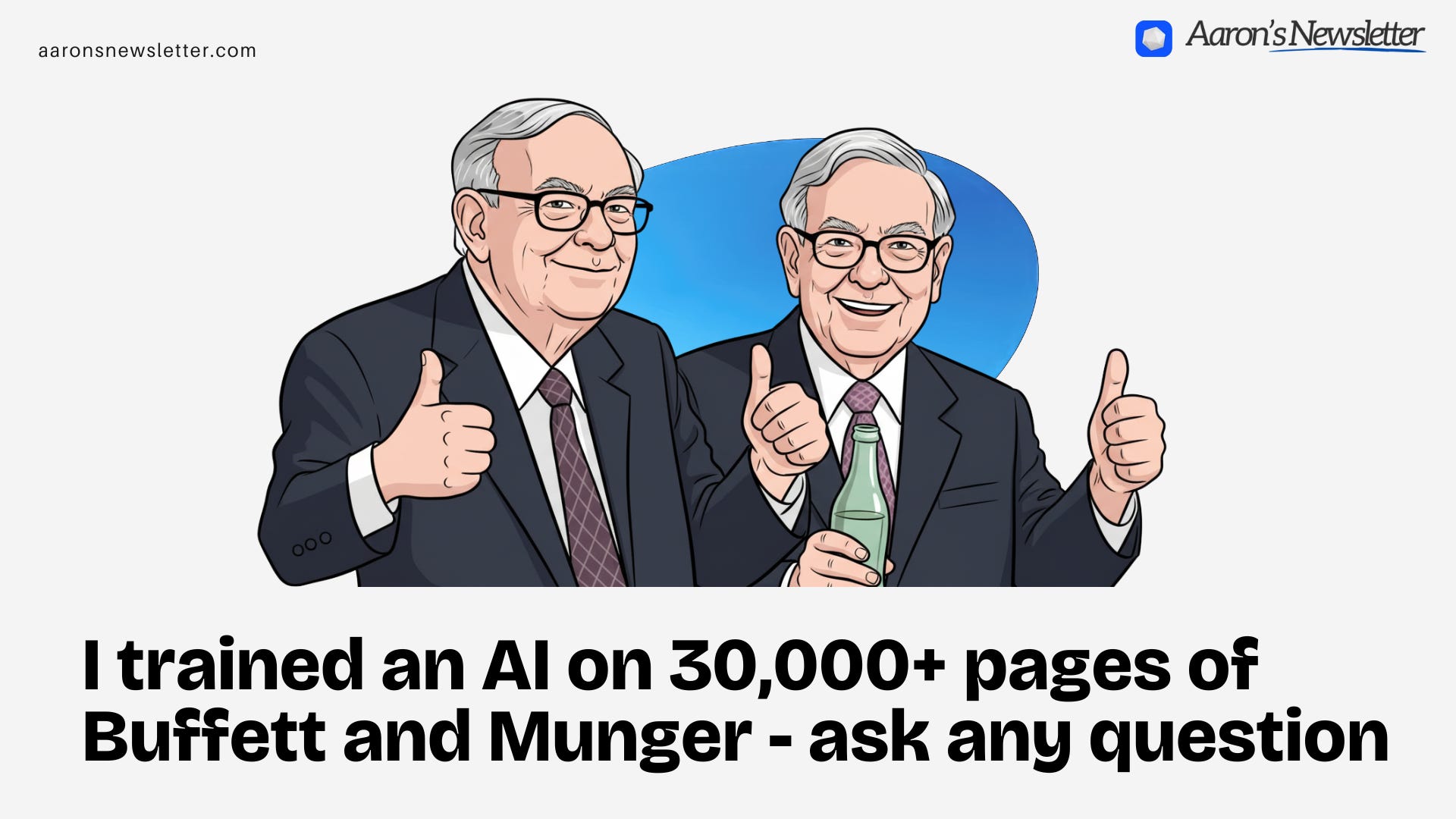
Over the last few weeks, I took 30,000+ pages of Warren Buffett and Charlie Munger’s public material partnership letters, Berkshire letters, annual meeting transcripts across decades, plus classic Munger writing… and used it to build a custom AI:
It’s a GPT that answers your questions in the style of the Berkshire Q&A:
Warren goes first: long, thoughtful, slightly rambling, very clear.
Then: “Uhh, Charlie?”
Charlie replies: shorter, blunter, funnier, and occasionally just says, “I have nothing to add.”
And, of course, lots of their classic business wit and humor.
You can talk to it for free with a simple ChatGPT login. I’ll explain how at the end—first, here’s what it actually is and how to get the most out of it.
What I actually built
I fed an AI a giant Berkshire “curriculum” that includes, among other things:
Buffett’s partnership letters
Decades of Berkshire Hathaway shareholder letters
Thousands of pages of annual meeting Q&A transcripts
Classic Charlie material (like Poor Charlie’s Almanack–style speeches and remarks)
Curated notes and compilations of their comments from 1994 onward
So when you ask it something like:
“I’m 28, work in tech, and I’m tempted to jump into real estate or private deals my friends are pitching. How would you think about this?”
You might get something along the lines of:
“Warren: Well, uh, the first thing I’d say is that envy and FOMO have probably destroyed more investment capital than any recession. When your friends are all getting rich in something you don’t understand, the easiest thing in the world is to forget about your circle of competence…
**Uhh, Charlie?”
Charlie: I think it’s pretty simple. If you can’t explain the deal in a couple of clear sentences, and you’re relying mostly on other people’s excitement, you’re not investing, you’re gambling politely…”
Obviously that’s AI Buffett and AI Munger.
But it’s drawing from what they’ve actually said across tens of thousands of pages, then remixing it into something conversational and specific to your situation.
What this GPT is good for
Think of it less like “stock tips” and more like an on-demand Berkshire-flavored thinking partner.
Here are the kinds of things it’s especially good at:
Investment philosophy & process
How to think about valuation, moats, margin of safety, circle of competence
Interpreting “Mr. Market,” temperament, patience, opportunity cost
Business analysis
“How would you evaluate a business like X?”
Tradeoffs between growth, capital intensity, pricing power, management quality
Career, money, and life decisions
“I’m 35 with kids and a decent job; should I start a business?”
“How would you think about taking a pay cut for more learning?”
Mental models & decision-making
Incentives, checklists, avoiding stupidity instead of seeking brilliance
Building good habits and avoiding the big, obvious disasters
Interpreting past Berkshire answers for your situation
“What would they say about index funds vs picking stocks today?”
“How would they react to meme stocks / crypto / AI bubbles?”
It’s surprisingly good at giving you Buffett first, then Charlie as the sharper scalpel.
What it can’t do (important)
Just to be very clear:
It is not Warren Buffett or Charlie Munger.
It has no access to any private information, deals, or internal Berkshire data.
It will not predict what stock is going up next week.
It will sometimes be confidently wrong or oversimplify. It’s still an AI model.
Nothing it says is financial, legal, or tax advice. It’s an educational tool, not an advisor.
Treat it like a very well-read, slightly nerdy Berkshire super-fan that’s been force-fed every letter, transcript, and quote we could find, and told to answer as if it’s on stage in Omaha.
You still have to think for yourself. As Charlie would say: “You can’t outsource the brain work.”
How to use it for free
Here’s how to try it:
Click the link / button in this post
I’ll put the “Ask Munger & Buffett – Berkshire Annual Meeting” link at the top and bottom of this article.Log into ChatGPT (or create a free account)
You don’t pay me anything to use it. You just need a ChatGPT account.Start asking questions like you’re at the Berkshire mic
Literally write to it as:
“Warren and Charlie, I’m 31, work as a software engineer, have $40k invested in index funds, and I’m wondering whether I should…”
Give it context
The more background you provide, the more specific and useful the answer:Your age, rough financial situation (high-level, no sensitive details)
Your goals (retire early, start a business, become a better investor, etc.)
Any constraints (student loans, kids, risk tolerance)
Ask follow-ups
Just like at the real meeting, you might not get the exact angle you wanted the first time. Ask:
“Okay, but what if I’m more risk-tolerant?”
“How would you apply this to real estate in particular?”
Example questions you can try
You can copy–paste or tweak these:
“Warren and Charlie, I’m 27 and just getting started investing. If you were in my shoes today, how would you structure a simple, sane plan for the next 10–20 years?”
“What are the most common ways smart people blow up financially, and how would you suggest I avoid them?”
“I’m considering leaving my job to start a small business. What mental checklist would you run through before making that jump?”
“How should I think about buying individual stocks vs using index funds, given I have a demanding full-time job?”
“Can you walk me through how you’d evaluate a subscription software business with high growth but no profits yet?”
“What are the key temperament traits you’d focus on if your goal is to be a good long-term investor while still sleeping well at night?”
“How would you apply your ideas about incentives and human misjudgment to social media and modern tech companies?”
The model has been nudged to answer like this:
Warren: long-form, stories, history, context, principles.
“Uhh, Charlie?”
Charlie: short, crankier, brutally clear, sometimes disagreeing, sometimes saying, “Nothing to add.”
Why I bothered doing this
Berkshire’s culture has always been very “apprenticeship-based”:
Read the letters.
Watch the meetings.
Think slowly, over years.
Let the ideas soak in.
That’s powerful, but also intimidating for people getting started. Newer investors look at a wall of PDFs and 3-hour Q&A sessions and think, “I’ll get to this someday.”
This GPT is my attempt to make that type of Berkshire education interactive:
You don’t have to remember which letter or year a quote came from.
You can ask the same question ten different ways.
You can push back, add nuance, and get a Warren/Charlie-style reply tuned to your situation.
Will it ever replace actually reading the letters? No. BUT, it might be the thing that pulls you into reading them more deeply and thinking more clearly about your own decisions.
Try it and send me your best exchanges
If you want to experiment with it:
👉 Ask Munger & Buffett – Berkshire Annual Meeting
If you get an answer that really hits you—funny, insightful, or surprisingly on-point—feel free to:
Reply to this email
Or comment on the post below
Or screenshot and share (just redact any personal details)
I’d love to see what kinds of questions you’re asking… and what “Warren” and “Charlie” have to say about them.
More from me:
Become a master pitcher & inventor – the fun way
Products: The Card Game: Get my game where ‘Shark Tank’ meets Apples to Apples.
Wanting to stay ahead in search? Get my FREE AI Visibility chrome extension
Aaron’s AI Visibility Extension: I wanted a simple way, right inside the browser, to see: “If an AI model or search engine reads this page, what does it actually see?”
Share the newsletter and get rewards
Refer friends for rewards: Get cool rewards (like my card game) for referring people to my newsletter. Check out where you stand on the leaderboard.