


First of all, to clear things up, I am not anti-AI. I’m not anti-technology. I use these tools every day. I think AI is genuinely transformative and, in many cases, genuinely good.
However, what I am is pro-community, pro-transparency, and increasingly convinced that the way we’re building AI infrastructure right now is repeating a very familiar mistake — moving fast, overpromising benefits to local communities, and leaving residents to figure out the consequences after the fact.
That’s what this newsletter is about.
The invisible cost of every prompt
You typed a question into ChatGPT this morning. Maybe you asked it to clean up an email, summarize an article, or help you think through a decision. It answered in seconds. You moved on with your day.

However, there is one fact that you probably didn’t think about… that chat exchange drank roughly a bottle of water.
Not metaphorically. Physically. Somewhere in a warehouse-sized building in Virginia, Texas, or Arizona, a cooling system pulled real water from a real source to keep the servers that processed your prompt from overheating.
Most of that water didn’t go back — it evaporated into thin air.
Multiply that by billions of prompts a day, and you start to understand why some communities are watching their wells run dry.
So, where does the water actually come from
This is worth explaining specifically, because most people picture data centers as some abstract cloud facility — not something that physically connects to the water pipe running under their street.
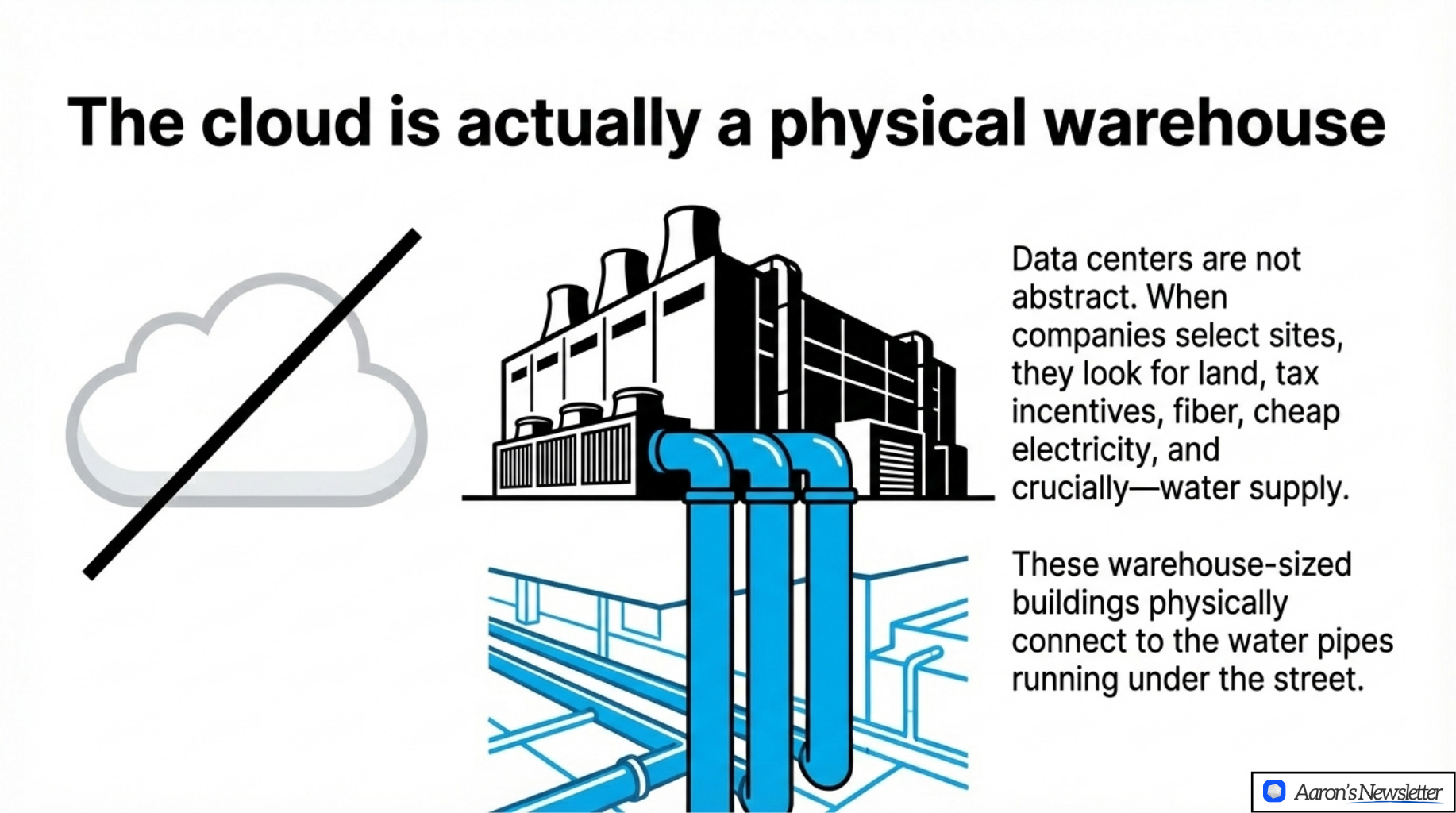
When a company decides to build a data center, they evaluate locations based on a few key factors — available land, favorable tax incentives, access to fiber infrastructure, cheap electricity, and water supply. The water question is a pretty big deal. These facilities require enormous, continuous cooling capacity to keep their servers from overheating.
Once a site is selected, there are typically three ways it gets water:
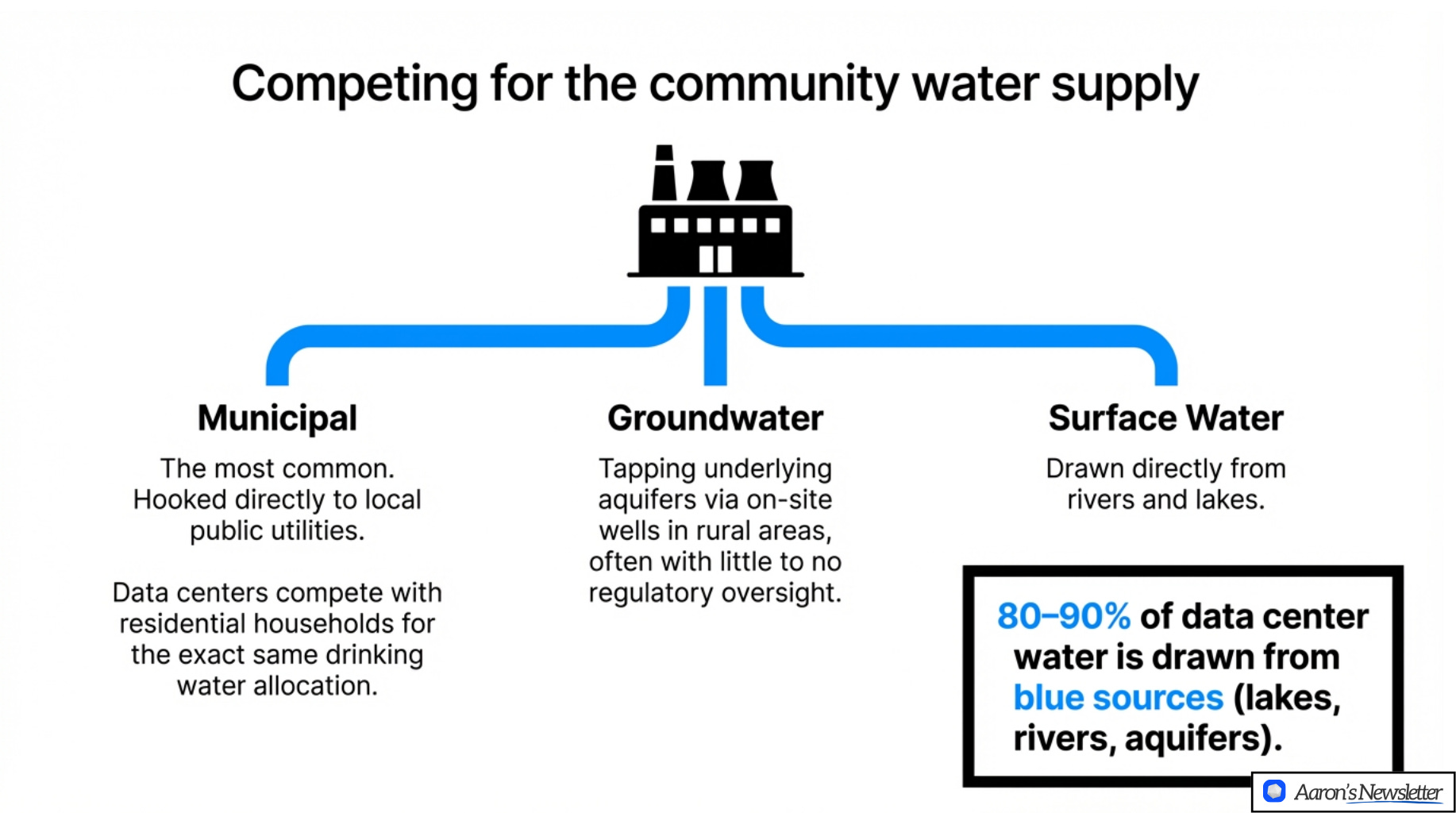
1. Municipal water supply
This is the most common. In most cases, data centers source their water directly from local public water utilities via their potable drinking water delivery systems — the same pipes that supply homes, businesses, and farms. That's right: in many cases, a data center is competing with residential households for the same municipal water allocation.
2. Groundwater via on-site wells
In some instances, particularly in remote or rural locations, data centers tap into underlying aquifers directly through on-site wells. This is especially common in areas where municipal infrastructure can't meet demand — and it often happens with little to no regulatory oversight.
3. Surface water from rivers and lakes
Some data centers draw directly from nearby bodies of water, which is why you'll find them clustered along rivers like the Mississippi.
One industry assessment found that 80–90% of the water used by data centers is drawn from “blue” water sources — lakes, rivers, or aquifers — often the same sources that provide community drinking water. In practice, many data centers simply hook up to the local water mains.
The critical part is that approximately 80% of the water withdrawn by data centers evaporates.

In other words, the water isn’t recycled. It doesn’t come back. It’s gone — drawn from the same finite sources communities depend on, then vented into the atmosphere.
Let’s talk scale
Each 100-word AI prompt is estimated to use roughly one bottle of water. Not the electricity — the water, just to keep the chips cool.
Note that this estimate was from a 2023 study, and the ratio has likely improved with newer models, but the reality remains.
A medium-sized data center can consume up to 110 million gallons of water per year — equivalent to the annual usage of approximately 1,000 households. Larger data centers can each consume up to 5 million gallons per day, equivalent to a small town of 10,000 to 50,000 people.
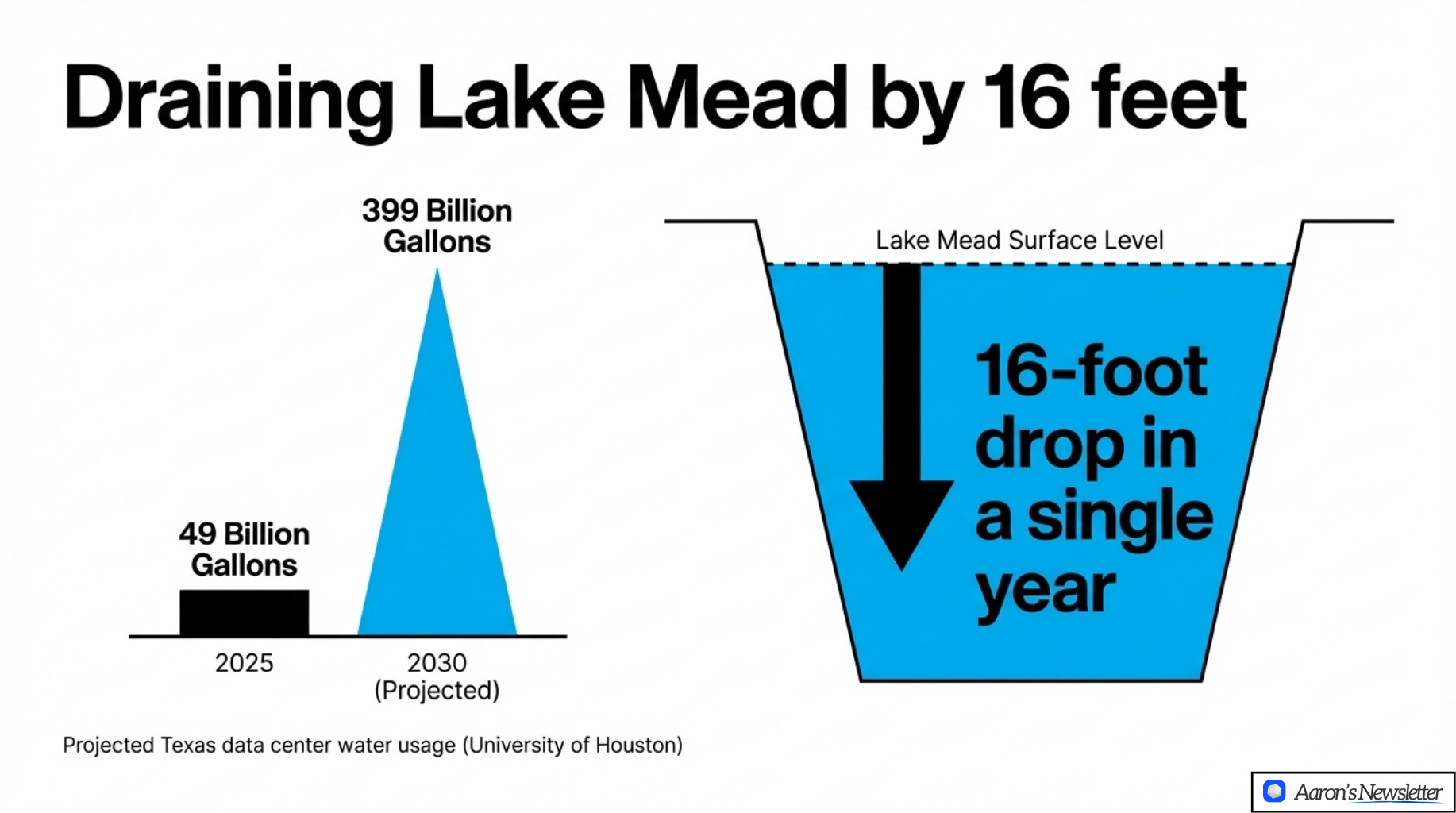
A study by researchers at the University of Houston found that data centers in Texas alone will use 49 billion gallons of water in 2025, and as much as 399 billion gallons in 2030 — equivalent to drawing down Lake Mead, the largest reservoir in the United States, by more than 16 feet in a single year.
And most of this is being built in places that are already water-stressed. Phoenix. Las Vegas. The Sun Belt. The desert Southwest — regions chosen for their cheap land and favorable tax environments, not their abundant water supply.

We’ve seen this movie before… Bitcoin Mining
If you’ve been paying attention to the crypto space over the last few years, this story has a familiar structure.
When Bitcoin mining operations started setting up in small towns across America — lured by cheap power, cheap land, and minimal regulation — they came with promises of economic revitalization. Good jobs. Tax revenue. Community investment.

What many communities actually got was different. Complaints about bitcoin mining noise make headlines more often than the average investor realizes. Mining noise turned a small town in North Carolina against its local miners. Residents in rural Ohio complained to their planning commission. As did Niagara Falls residents. A Montana county voted unanimously to pass new zoning rules for current and future mining operations.
In Granbury, Texas, residents near a massive Bitcoin mining facility described a constant roar — the sound of nearly 60,000 computers cooling around the clock, less than 100 yards from mobile homes where dozens of families live. A 2,000-foot, 24-foot-tall soundproofing wall was installed. Residents say it did little. Some are trying to incorporate their neighborhood into a new city just to gain the legal standing to create a noise ordinance.
This pattern has many parallels. An industry moves into a community with promises of economic benefit, operates with minimal transparency, imposes real costs on residents, and then points to its tax contributions when confronted. The residents who organized, complained, or tried to fight back were often characterized as anti-progress, anti-jobs, and anti-technology.
Sound familiar?
AI data centers aren’t noisy in the same way Bitcoin mines are. But the underlying dynamic — industries imposing costs on communities that never got a real vote — is identical. The medium is different. The model is the same.
The job’s promise doesn’t hold up
One of the primary arguments used to gain community approval for data centers is job creation. And I want to address this directly, because it’s the argument most likely to be used to dismiss legitimate concerns: “Think of the jobs.”
The data tells a more complicated story.
Most of the jobs created by data centers are short-term construction jobs that disappear once the building is finished. After that, a mega data center — the size of dozens of football fields — operates with only a few dozen permanent workers. And as AI and automation expand, even those jobs are shrinking.

A 2025 brief from University of Michigan researchers put it plainly: “Data centers do not bring high-paying tech jobs to local communities.” A recent analysis found that in Virginia, the investment required to create a permanent data center job was nearly 100 times that required to create comparable jobs in other industries.
The University of Michigan also found that the jobs data centers do create locally are “typically low-wage, term-limited, non-technical positions such as security, maintenance and janitorial work.”
The subsidy picture is also troubling. Almost half of state data center subsidies do not require any job creation at all. When the Indiana governor announced a Google data center and touted 200 jobs, Google was not legally obligated to create any jobs in exchange for its subsidy. A local agreement stipulated only 30 permanent positions.
The industry has spent millions on marketing to counter this narrative. One industry-affiliated group spent at least $700,000 on digital marketing in Virginia alone in 2024, running ads emphasizing job creation and clean energy investment — targeted primarily at policymakers rather than local residents.

To be fair, there is a genuine case to be made for construction employment and local tax revenue — and in some communities, that revenue is substantial. Loudoun County, Virginia, collects nearly $900 million annually from data center taxes. But tax revenue and community benefit are not the same thing. A community can be a net recipient of tax dollars and still have its water table depleted, its power grid strained, and its residents making decisions based on promises that were never legally required to be kept.
The transparency gap
The core of my argument (whic I don’t think is too crazy) is that communities deserve to know what they’re agreeing to.
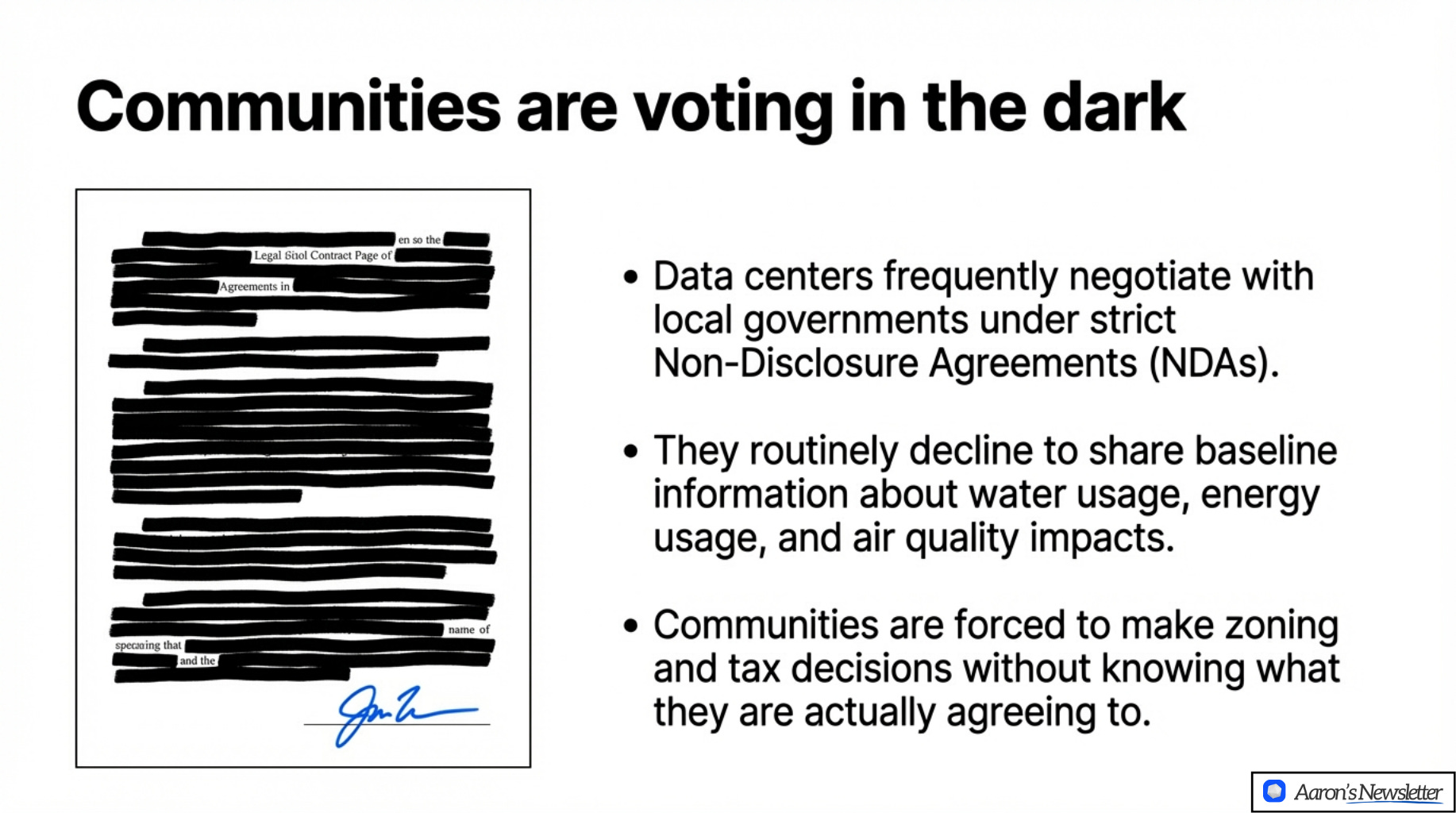
Very often, data centers negotiate with local governments under non-disclosure agreements. They frequently decline to share information about water usage, energy usage, and air quality impacts. Communities are expected to make decisions about zoning, infrastructure investment, and tax incentives without basic information about what they’re actually agreeing to.
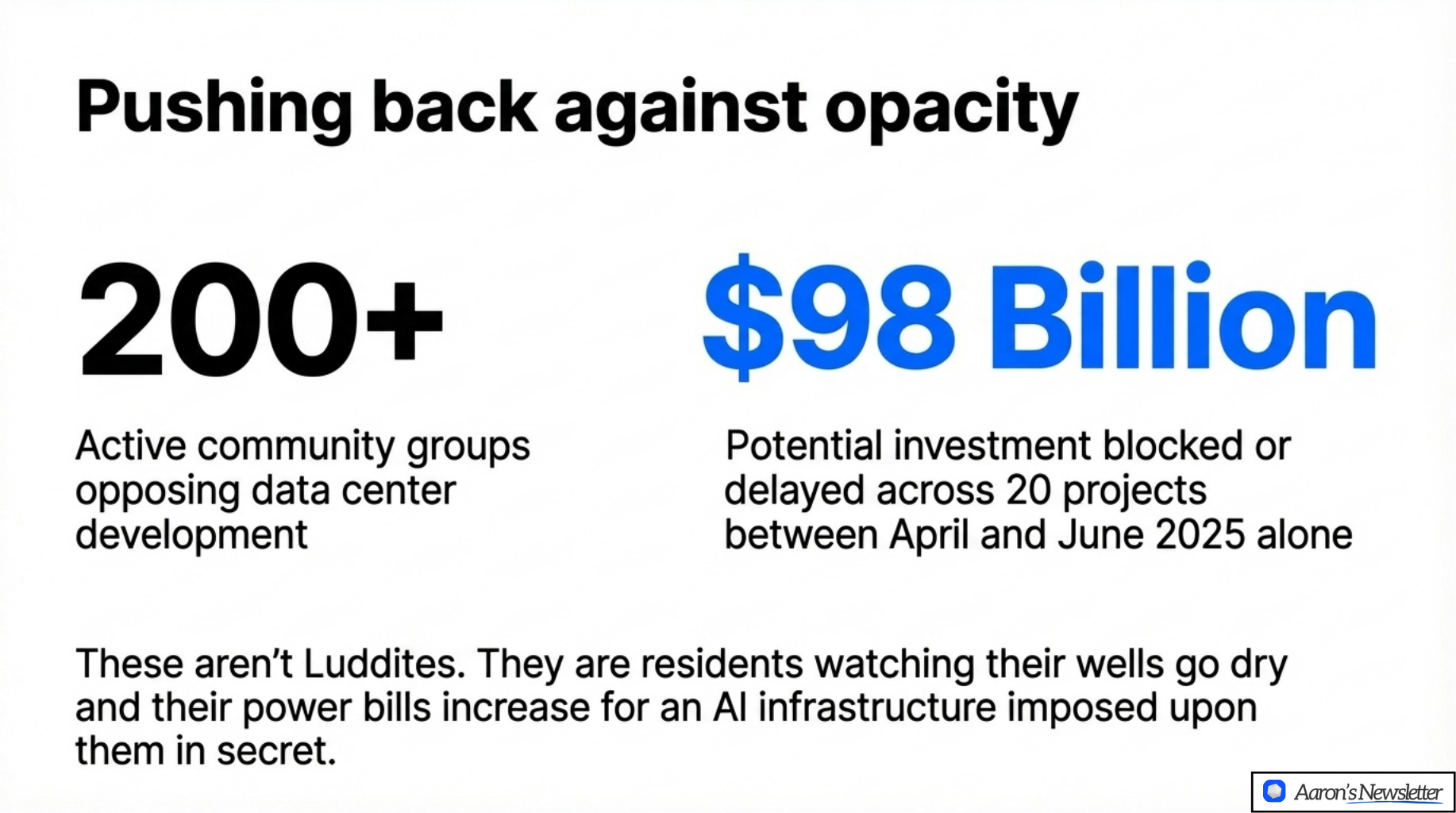
Nearly 200 community groups across the country are currently active in opposing data center development. Between April and June 2025 alone, community opposition blocked or delayed 20 data center projects representing $98 billion in potential investment.
These aren’t Luddites. They’re residents who have watched their wells go dry, seen their power bills increase, and been told it’s all for the greater good of AI — which, by the way, they may or may not use.
Some communities have started pushing back effectively. In Lancaster, Pennsylvania, a community benefits agreement committed data center developers to a water-use cap, noise and emissions controls, and a $20 million contribution to local economic and sustainable development. That’s what it looks like when a community has real information and real leverage.
That should be the standard, not the exception.
How can we be pro-AI and pro-community?
The technology to build more sustainable data centers exists right now. Direct-to-chip cooling, closed-loop water systems, immersion cooling, smart site selection — Cornell researchers found that combining these approaches could reduce water consumption by 86% and carbon emissions by 73%. The solutions aren’t sci-fi.

The barrier isn’t technical. It’s that nobody is requiring companies to use them. Tax incentives aren’t tied to water conservation commitments. Permits don’t require disclosure of consumption data. NDA agreements let companies walk into communities with promises that no one enforces.
To be genuinely fair, there is a serious counterargument here. And, it deserves a direct response. The strongest case for tolerating the resource costs of AI infrastructure goes something like this — AI will accelerate drug discovery, reduce energy waste across entire industries, dramatically improve agricultural efficiency, and generate productivity gains that dwarf the water and electricity consumed to build it.
On a long enough time horizon, the argument goes, a data center in Phoenix that depletes a local aquifer might be a reasonable trade for the infrastructure that cures a disease or decarbonizes a supply chain. That argument is not crazy. It might even be right.
But the problem I have is that the communities hosting these facilities aren’t the ones making that calculation. The trade-off is being decided by investors, hyperscalers, and state-level officials chasing tax revenue — not by the family in Georgia whose well ran dry, or the residents of Granbury who can’t sit on their porch because of the noise. The benefits of AI are diffuse and global. The costs of AI infrastructure are local and specific. That asymmetry is the issue.
If the productivity gains are real and large, then the industry can afford to compensate communities properly, disclose what it’s taking, and build with consent rather than around it.
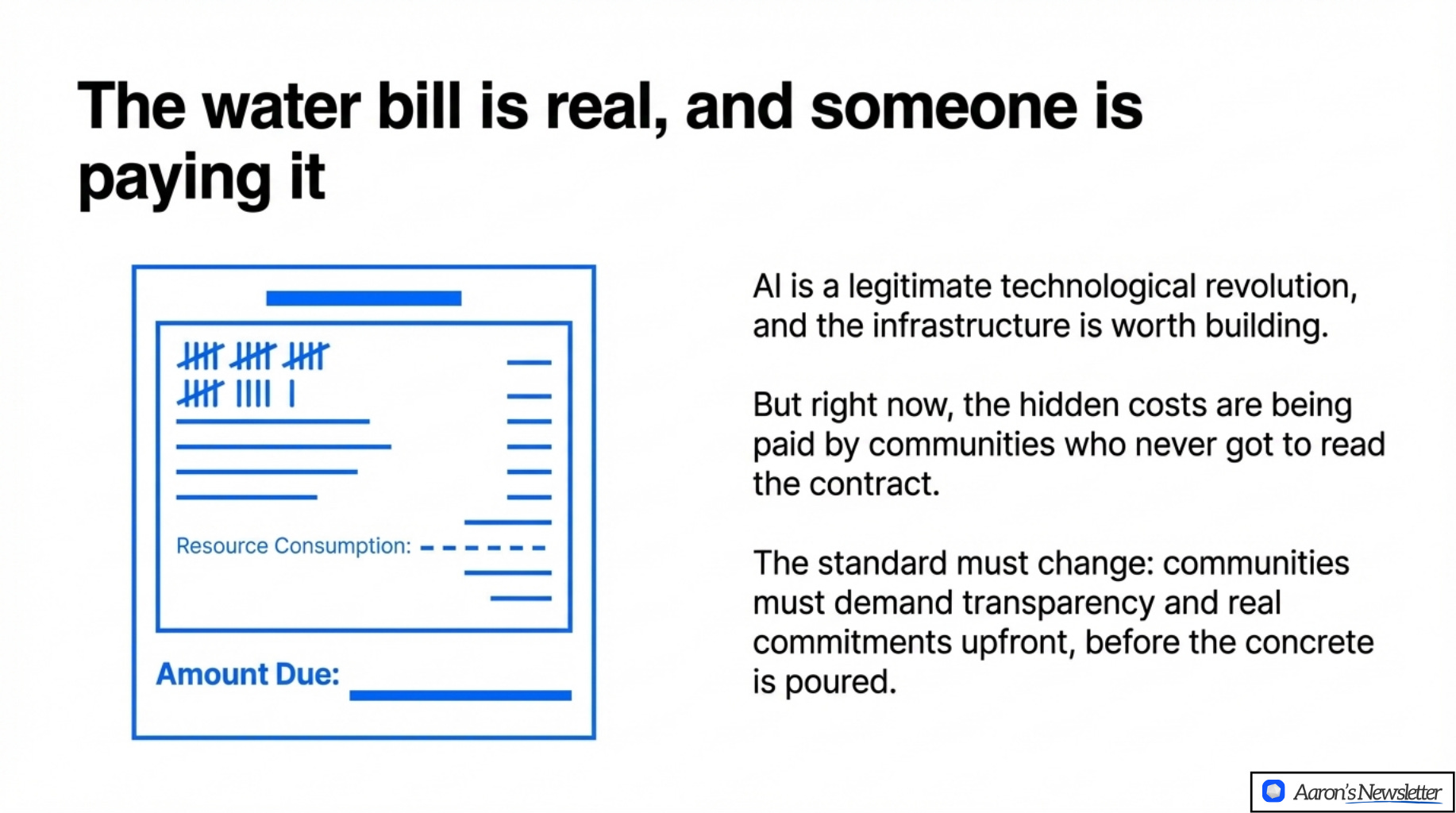
AI is a legitimate technological revolution. The infrastructure behind it is real, necessary, and worth building. But the way we’re building it right now — with opacity, with overstated job promises, with communities absorbing costs they didn’t agree to and can’t quantify — is a version of a story we’ve already lived through with Bitcoin mining operations
.
The lesson from all of them is the same: communities that demand transparency and real commitments upfront are far better off than those who find out later what they signed up for.
The water bill is real. Someone is paying it.
Right now, it’s mostly the communities that never got to read the contract.
More from me:
Learn how to pitch a business the fun way.
Products: The Card Game: Get my game where ‘Shark Tank’ meets Apples to Apples.
Wanting to stay ahead in search? Get my FREE AI Visibility Chrome extension
Aaron’s AI Visibility Extension: I wanted a simple way, right inside the browser, to see: “If an AI model or search engine reads this page, what does it actually see?”
Share the newsletter and get rewards
Refer friends for rewards: Get cool rewards (like my card game) for referring people to my newsletter. Check out where you stand on the leaderboard.
One consideration, data centers are highly mobile, and subject to change over time.